

On October 13 and 14, 2026, another exchange meeting with representatives from the Tartu Observatory took place, this time at the Volkshaus in Jena. Dr. Eike Guenther, a researcher at the Thuringian State Observatory, had successfully applied for funding from the DFG (German Research Foundation) to expand the collaboration with the Tartu Observatory in Tõravere, Estonia.
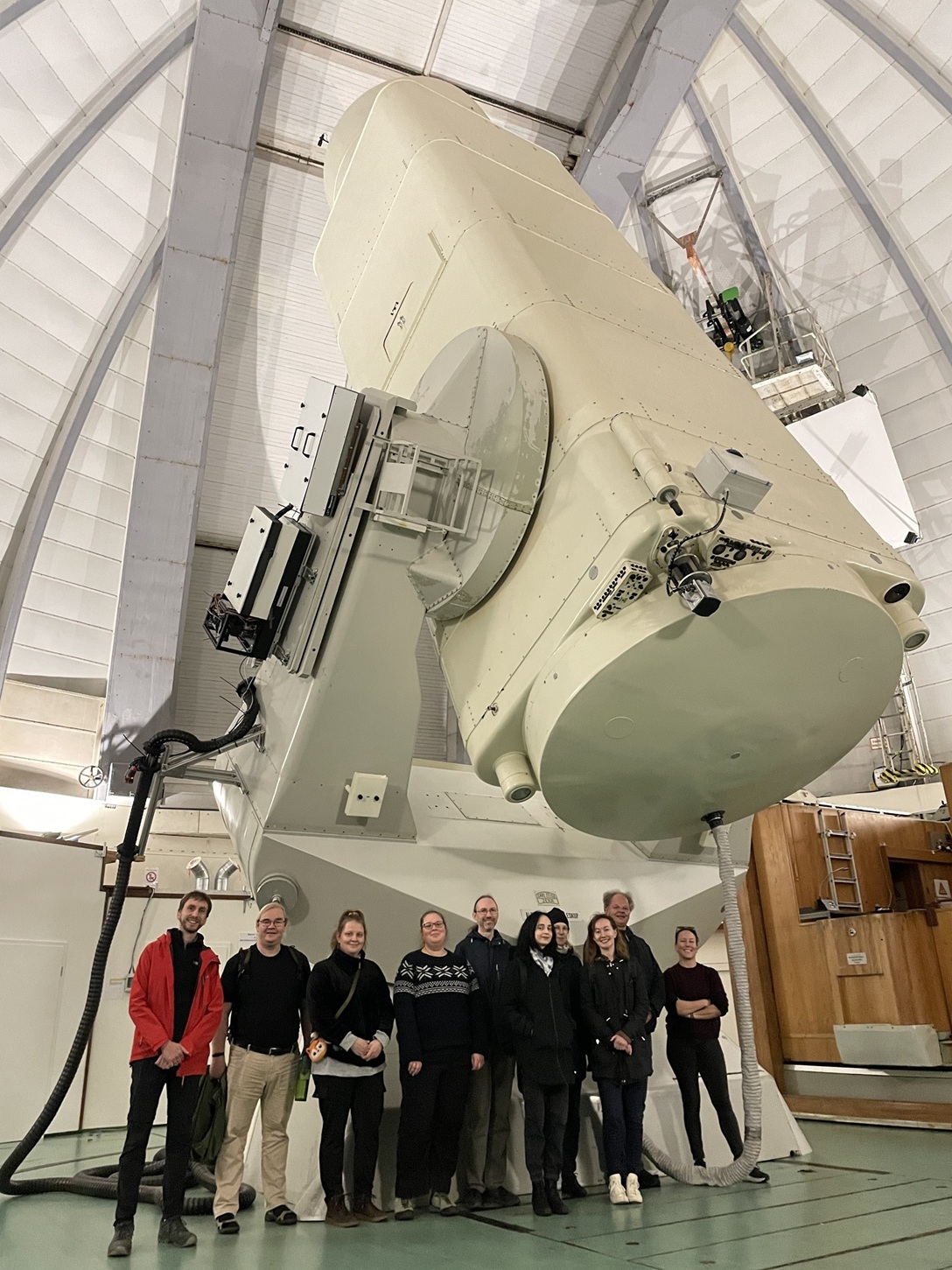 In late August 2026, a group from the Thuringian State Observatory (TLS) traveled to Tartu for a workshop. In mid-October, scientists from Tartu visited Thuringia. After a two-day workshop in Jena, they toured the Thuringian State Observatory on the third day.
The collaboration between the Thuringian State Observatory and the Tartu Observatory has been in place since January 2025. Both institutions operate telescopes of similar size. Tartu has a 1.5-meter telescope, while the TLS has a 2-meter telescope. Both are equipped with Echelle spectrographs.
Academic Exchange and a Joint Ph.D. Student
The exchange program also includes extended stays by researchers at each other’s institutes. Veronika Schaffenroth and Eike Guenther, both of whom work at the Thuringian State Observatory, spent an extended period in Tartu. Heleri Ramler, an astronomer at the Tartu Observatory, spent several weeks in Tautenburg. Heleri Ramler and Eike Guenther are jointly supervising a doctoral student. This joint supervision is also a result of the exchange.
The Tartu Observatory is participating in the ESA mission ARIEL (Atmospheric Remote-sensing Infrared Exoplanet Large-survey) and specializes in the analysis of hot stars. The ARIEL satellite telescope will record spectra of planets outside our solar system. The goal is to determine the composition of the atmospheres of exoplanets. Researchers in Tartu are involved in selecting ARIEL targets and characterizing them.
The search for and characterization of exoplanets is also a key area of research at the Thuringian State Observatory. The TLS is part of an international consortium that has modernized the European Southern Observatory’s 1.52-meter telescope at La Silla, Chile, and equipped it with a high-resolution spectrograph.
Using this instrument and the telescope at La Silla, the Thuringian State Observatory in Tautenburg will support the ESA’s PLATO mission with observations. As part of the PLATO project, the size, age, and ultimately the mass of the planets will be determined. Eike Guenther explains the shared research goal: “By combining the mass, radius, age, and atmospheric composition of planets, we can determine where and how they formed.”
In the future, the two astronomical research institutes plan to collaborate on the search for exoplanets. “We are focusing on hot planets orbiting hot stars, particularly those observed by PLATO and ARIEL. So far, for many of them, we only know that they exist - nothing more. We will now work together to conduct intensive observations of these stars and their planets.”