

A photograph of the Alfred Jensch Telescope in Tautenburg is on the cover of a recently published anthology on astronomy in the German Democratic Republic (GDR). Published by Akademische Verlagsanstalt Leipzig, the collection includes studies, essays, and memoirs.
This is the first time that a historical overview has been dedicated to astronomical research in the GDR. The anthology “Astronomy in the GDR,” edited by Wolfgang R. Dick and Peter Ackermann, presents astronomical research institutions in the Soviet Occupation Zone (SBZ) and the GDR, including Potsdam, Jena, and Dresden. A list of dissertations in astronomy provides an overview of research topics. The essay on the political history of the Astronomische Gesellschaft offers insight into German-German relations.
Furth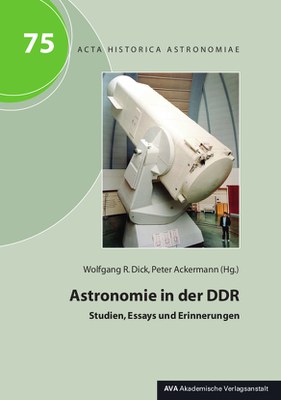 ermore, the book, published in the “Acta Historica Astronomiae” series (Volume 75), describes the lives and work of eight influential astronomers, including Cuno Hoffmeister and Hans Kienle. These eight influential figures exemplify different paths of development in the GDR. Kienle played a key role in the establishment of the Karl Schwarzschild Observatory in Tautenburg with its 2-meter universal telescope.
Dr. Michael Sigwarth, research associate at the Thüringer Landessternwarte, co-authored the biography of Wolfgang Mattig. Mattig was a renowned solar physicist and cosmologist at the Freiburg Institute for Solar Physics (KIS). He had begun his career at the Einstein Tower at the Astrophysical Institute in Potsdam. In 1961, the Einstein Tower was - from a scientific perspective - excellently equipped for the spectroscopic study of the Sun. From there, he moved to the Fraunhofer Institute in Freiburg (todays name is Institute for Solar Physics), which was rather poorly equipped at the time. “Over time, that situation was reversed,” says Sigwarth and adds: “Many of the memoirs and biographies give a sense of the sometimes difficult technical and personal conditions under which outstanding research was conducted in the GDR.”
2-meter telescope at Karl-Schwarzschild observatory was an important research facility
The history of the Karl Schwarzschild Observatory (KSO) in Tautenburg (now the Thüringer Landessternwarte) is not covered separately in this volume. However, KSO is mentioned repeatedly in numerous articles, as the observatory held particular significance for astronomers in the GDR. After all, it was the largest optical telescope in Germany at the time.
“Acta Historica Astronomiae” is a monographic series on the history of astronomy that has been published since 1998 by the Working Group on the History of Astronomy within the Astronomische Gesellschaft (AG).
Bibliographic information: Wolfgang R. Dick, Peter Ackermann (Herausgeber): Astronomie in der DDR (Acta Historica Astronomiae; Band 75), erschienen in der Akademischen Verlagsanstalt, Leipzig, 2025, ISBN 978-3-944913-67-4
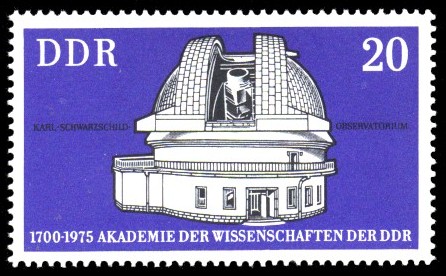 |
| Wie wichtig das Karl-Schwarzschild-Observatorium für die Astronomie in der DDR war, zeigt auch diese DDR-Briefmarke. Am 2. Juli 1975 war ihr Ausgabetag. Die Marke war Teil des Briefmarkensatzes "275 Jahre Akademie der Wissenschaften der DDR". |