

The International Astronomical Union named a minor planet after a former scientist of the Thuringian State Observatory. Dr. David Alexander Kann had spotted the small object with our 2 meter Alfred-Jensch-Telescope while doing routine observations.
The working group "Small Bodies Nomenclature" (SBN) gives names to newly discovered minor planets. The names are published regularly. The first 2026 edition of the WGSBN (Working Group Small Bodies Nomenclature) bulletin, published on January 9, 2026, honors former TLS scientist Dr. David Alexander Kann, among others. The minor planet with the number 635817 is now named after him. Kann is already the fifth scientist from the Thuringian State Observatory to have a minor planet named after him. The others are Richter (number 3338), Börngen (3859), Solf (9872), and Stecklum (69295).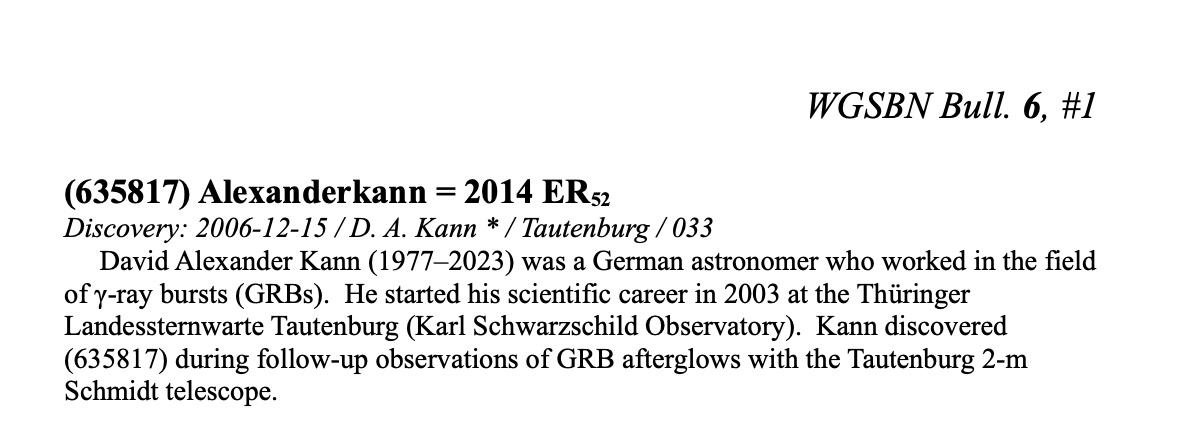
Kann had discovered the minor planet by chance
The discovery of the minor planet dates back 20 years. Kann found the celestial body in December 2006 while conducting follow-up observations of gamma ray bursts with the observatory's 2-meter telescope. Gamma-ray bursts (GRBs) are short-lived bursts of gamma rays. Lasting from a few milliseconds to several minutes, GRBs shine a hundred times brighter than a typical supernova. When a GRB erupts, it is briefly the brightest source of cosmic gamma rays in the observable universe.
Dr. Sylvio Klose, scientist at the Thuringian State Observatory, was Kann's thesis supervisor at the time. Kann carried out the observations on his behalf. “The discovery of the minor planet happened because of Alex Kann's enthusiasm. During a short break in our observation campaign at the time, he pointed our telescope at another interesting spot in the sky – and discovered the minor planet,” recalls Klose.
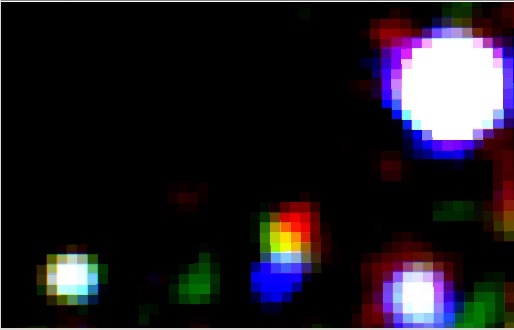 Kann detected the minor planet during routine follow-up observation with the 2 meter telescopeKann first spotted the celestial body on December 15, 2006, while conducting follow-up observations of gamma-ray bursts with the 2-meter telescope at the Thuringian State Observatory. Kann took three images with the 2-meter universal telescope in Schmidt mode, in which he identified the object. In the image on the left, these three images are superimposed in a color representation (red, green, and blue). The stars appear white because they remain in the same position in the images. The minor planet (the multicolored object), on the other hand, moved from southeast to northwest. Due to its low brightness, the contrast of the image is high to make it more visible. This is why noise (blurring) can be seen in the image.
A long tradition of finding minor planets with our 2 meter telescope
The Thuringian State Observatory has a long tradition of discovering minor planets. Freimut Börngen, a former scientist at the Karl Schwarzschild Observatory (as the observatory has been called since it was founded in 1960), specialized in finding these small celestial bodies orbiting the sun in the 1970s. He could name the minor planets he discovered. That is why, for example, a minor planet called Tautenburg orbits the sun today.
Dr. Bringfried Stecklum, scientist at the Thuringian State Observatory, has continued and significantly modernized the observations of asteroids that Börngen began around 50 years ago. Under his leadership, the Thuringian State Observatory has been involved in the classification and monitoring of near-Earth objects since 2010. Since 2019, this has been done in collaboration with the European Space Agency (ESA). With an average of 6,000 measured orbital positions per year, our research institute is now one of the most productive observatories in Europe in this field.
David Alexander Kann passed away in 2023 at a young age. Bringfried Stecklum initiated that the minor planet discovered by Kann be named after him. The minor planet with the number 635817 will now always commemorate David Alexander Kann.