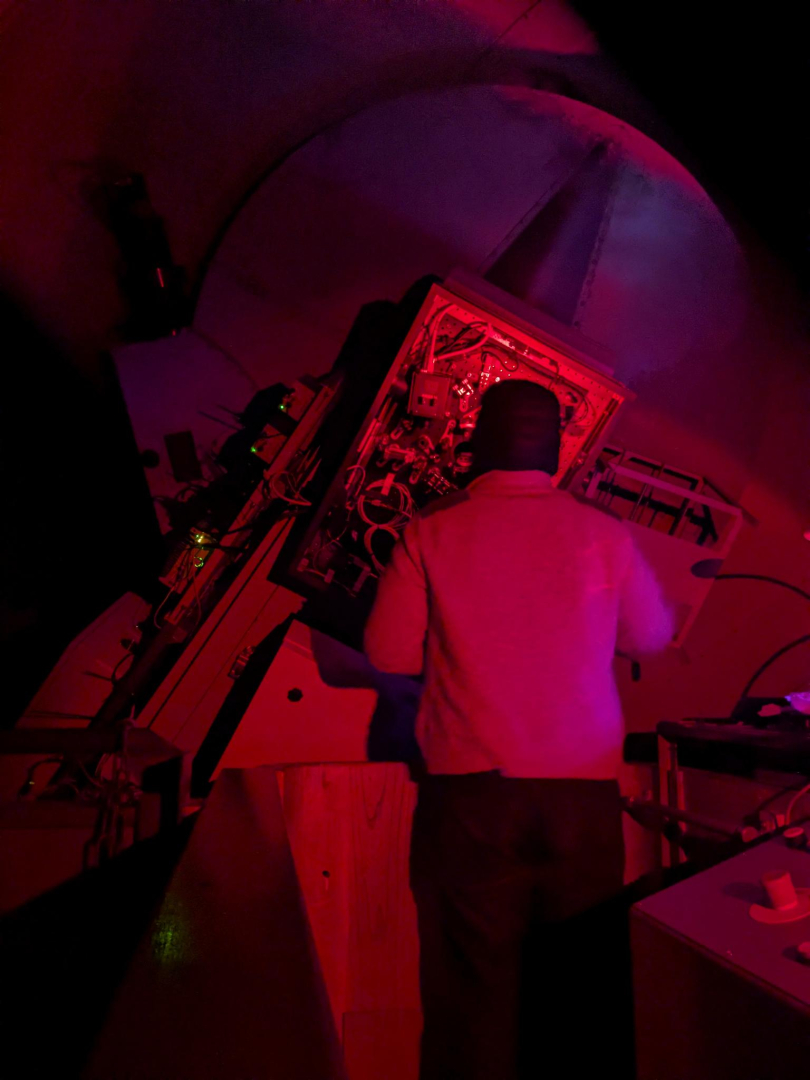
A new spectrograph was put into operation at the 2 meter Alfred Jensch telescope. At the end of April 2026, the workshop staff and the instrumentation team at the Thüringer Landessternwarte installed TauFOS, the Tautenburg Faint Object Spectrograph, together with a new front end. During the first few days of operation, numerous tests were conducted and initial scientific data was already collected.
The front end and the new spectrograph are the first components of our ongoing effort to modernize the optical telescope's spectroscopic instrumentation. Both were financed by the Free State of Thuringia.
TauFOS was primarily developed to study close binary star systems consisting of hot dwarf stars. These faint objects, with orbital periods of only a few hours, emit mainly blue or ultraviolet light. For this reason, the new instrument was designed to cover the blue spectral range from 370 to 540 nanometers with medium resolution (approx. 0.15 nanometers) and with the highest possible efficiency.
Fiber-optic coupling makes telescope use more flexible
The new front end serves as the interface between the optical telescope's Nasmyth focus and the spectrograph. What makes it special is that it features very fast active image stabilization to compensate for tracking errors of the telescope as well as "image jitter" caused by atmospheric turbulence. In addition, the new front end guides the starlight via a fiber optic cable to the spectrograph. This allows for much more precise wavelength calibration, which is important for the instrument’s intended use. It also makes it easy to switch between multiple fiber-coupled instruments. This makes the telescope’s overall use more flexible.
The "First Light" campaign is still ongoing. "First Light" refers to the initial test observations made by an observational instrument. Hans-Peter Doerr is responsible at Thüringer Landessternwarte for the development and construction of the two devices. He reports that the installation and commissioning went smoothly: „We were lucky to have many clear nights for testing and first scientific observations. So far, we are very satisfied with the data quality and the system performance, which fully meet our scientific requirements and in some cases even exceed our expectations.“
Instruments have been designed and built at the observatory
TauFOS and the front end have been designed and built at the Thüringer Landessternwarte. The transmission grating and the lens objectives have been custom-made by optics companies according to TLS' specifications. Both devices serve as a test-bed for technologies and methods used in future instrumentation projects at the observatory.
Step by step, the recently formed research group for optical technologies and photonics at TLS builds expertise and know-how. "For some people in our team, TauFOS was the first astronomical instrument which they helped build. There are still a few things we need to tweak. But that was to be expected. Over the coming months, we will gradually improve the configuration," says Doerr.
|
The new front end guides the starlight via a fiber optic cable |
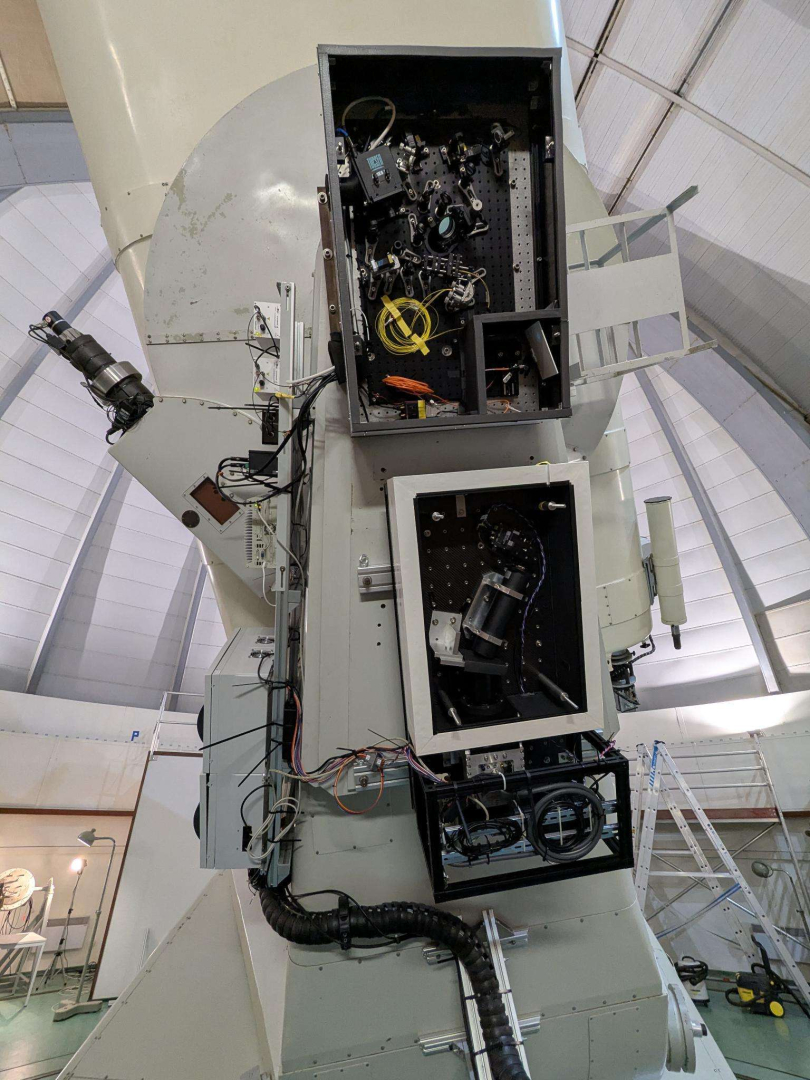 The front end and the new spectrograph are the first components The front end and the new spectrograph are the first components to modernize the optical telescope's spectroscopic instrumentation. Photos: Thüringer Landessternwarte |