

The Thüringer Landessternwarte participates in the Long Night of Sciences in Jena on November 20, 2026. Please join us for presentations and live observations with our radio telescope LOFAR. The address is Helmholtzweg 5 in Jena, lecture room 2, and in the Foyer.
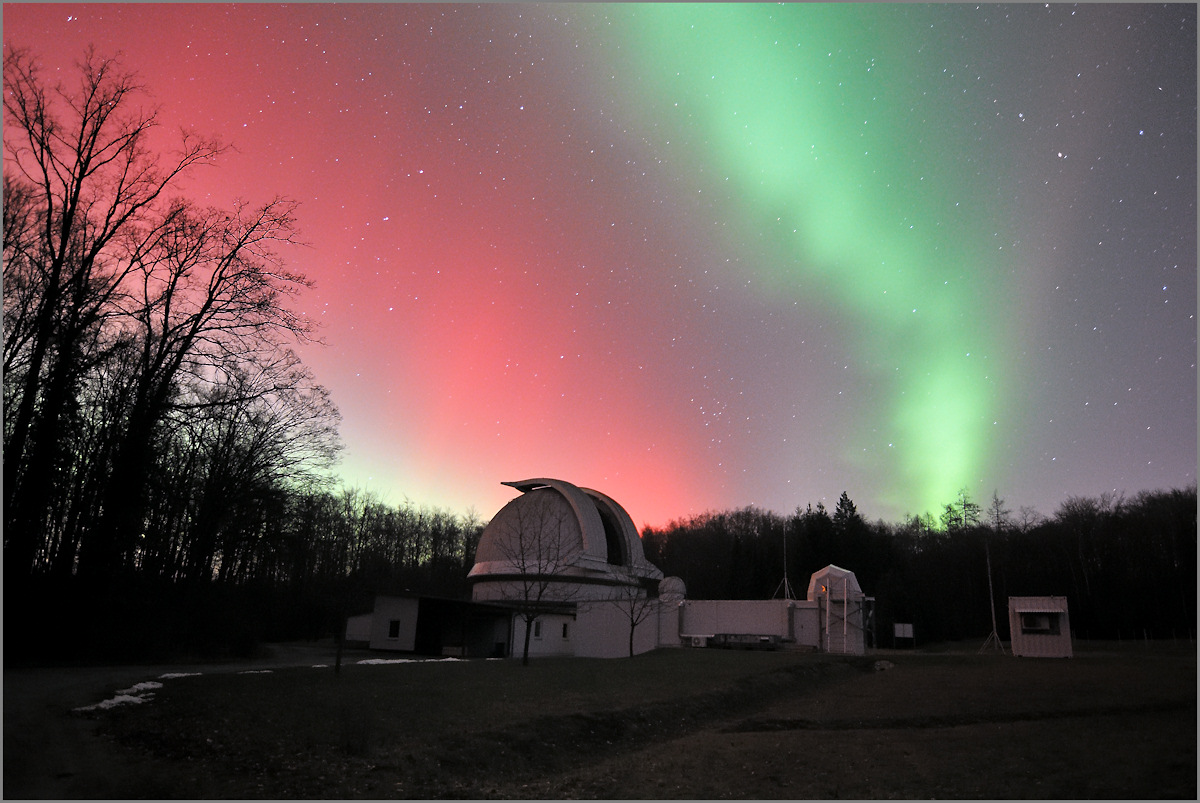 Polarlichter über der Thüringer Landessternwarte im Januar 2026. Foto: TLSThe presentations cover a range of topics on various phenomena: Why are there Northern Lights? What is a Nova? One science talk invites you to a journey to the center of our galaxy. We wil also explain how researchers find asteroids before they find us.
Zusätzlich zu den Vorträgen zeigen wir Live-Beobachtungen mit unserer Station des Radioteleskops LOFAR (Low Frequency Array). LOFAR ist derzeit das weltweit größte Radioteleskop. Es kann Objekte und Vorgänge am Himmel beobachten, die im sichtbaren Licht verborgen bleiben.
In addition to the talks, we will show live observations with our station of the radio interferometer LOFAR (Low Frequency Array). LOFAR is currently the world's biggest radio telescope. It sees objects and events in the sky that can not be discovered in the optical wave length.
Join us for the Lange Nacht der Wissenschaften in Jena. Learn how astronomical research is done today, what interesting discoveries have been made recently - and which questions are unanswered.
These are our science talks. (They will be held in German):
|
Uhrzeit |
Thema |
Sprecher |
|
18.00 Uhr bis 18.30 Uhr |
Near-earth Asteroids - Let's find them first, before they find us |
Dr. Bringfried Stecklum |
|
19.00 Uhr bis 19.30 Uhr |
A small journey to the center of the Milky Way |
Prof. Dr. Matthias Hoeft |
|
20.00 Uhr bis 20.30 Uhr |
Aurora - the Beauty and the Beast |
Dr. Jochen Eislöffel |
|
21.00 Uhr bis 21.30 Uhr |
Galactic fossils: Globular clusters |
Burak Kilic |
|
22.00 Uhr bis 22.30 Uhr |
ESA Mission PLATO: a new window to planets around other stars |
Dr. Eike Guenther |
|
23.00 Uhr bis 23.30 Uhr |
Cannibalism in space: When binaries turn into novae |
Dr. Veronika Schaffenroth |