

It is not an event that you see every day (or in this case: every night): The meteor camera at the Thuringian State Observatory recorded a very bright fireball during the night of November 18, 2025. The European Fireball Network, run by scientists at the Astronomical Institute of the Czech Academy of Sciences, analyzed recordings of this meteoroid. Here is what they found out about this spectacular celestial event that lasted only a few seconds.
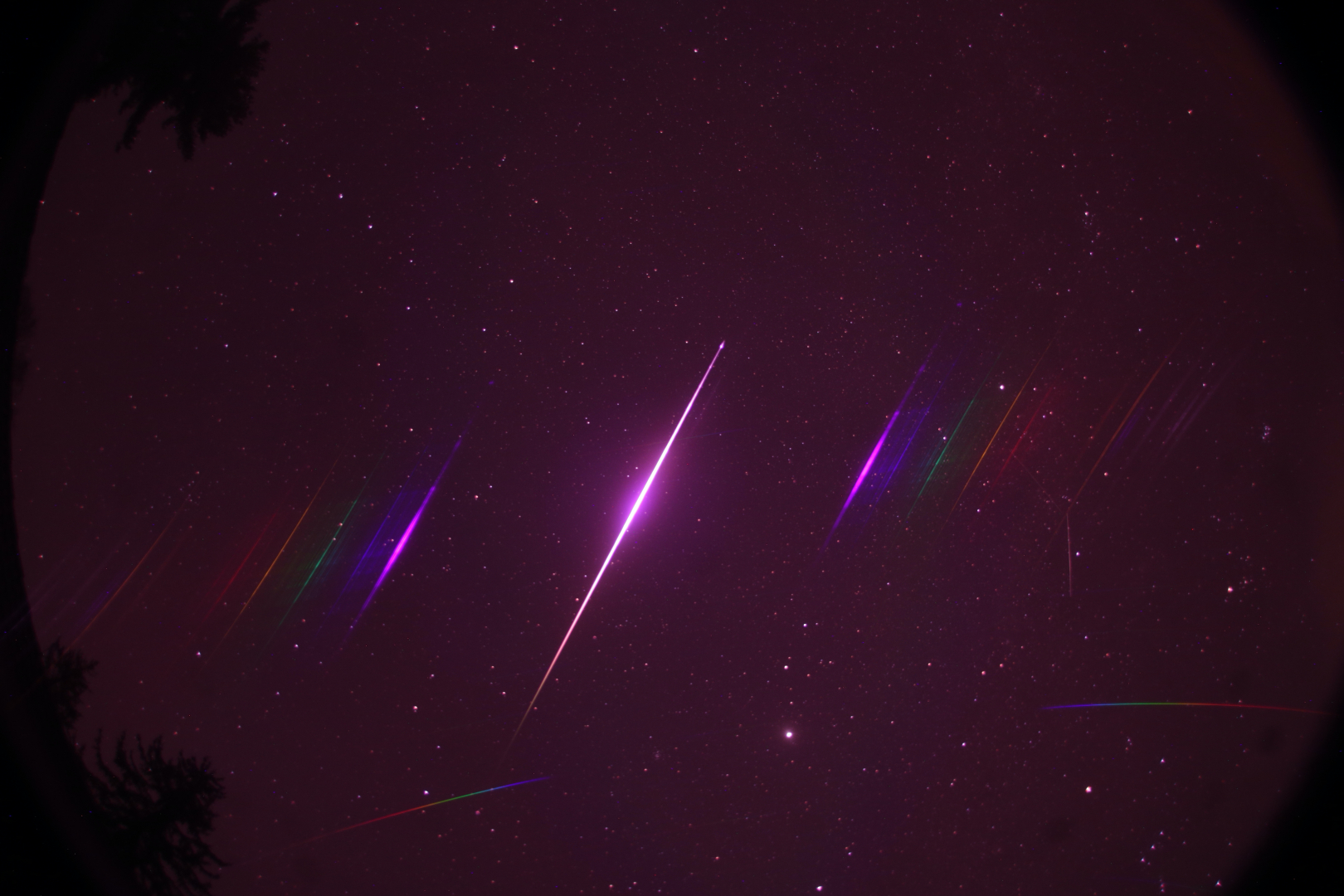 A fireball recorded by the meteor camerat at Tautenburg. Photo: Astronomical Institute of the Czech Academy of Sciences
The fireball was visible for only two seconds, but that was long enough to leave a bright streak on the meteor camera at the Thuringian State Observatory. Asteroids and meteoroids enter the Earth's atmosphere all the time. When they burn up, they turn into shooting stars (meteors). If part of them makes it all the way to Earth, the piece of rock is called a meteorite. Sometimes meteors appear even brighter than the planet Venus – then they are called “fireballs”.
In order to study meteoroids more closely, the European Fireball Network, based at the Astronomical Institute of the Czech Academy of Sciences in Ondřejov, has distributed special meteor cameras across a large area of Central Europe. One of them is located at the Thuringian State Observatory.
The bolide (a technical term for the fireball) that briefly lit up the sky above Tautenburg on November 18, 2025, was observed by special cameras belonging to the European Fireball Network. Since almost all of the meteor cameras closest to the fireball's trajectory had clear skies (translating into a clear view), the recordings enabled a thorough analysis. The Czech astronomers were able to use the images to study its trajectory and other parameters.
The fireball flew practically directly over the Thuringian State Observatory. Using a wide-angle spectral camera, it was possible to capture an exceptionally bright and detailed spectrum of the fireball. Pavel Spurný, a researcher at the Astronomical Institute of the Czech Academy of Sciences, recently published this data:
Meteor camera recordings enable analysis
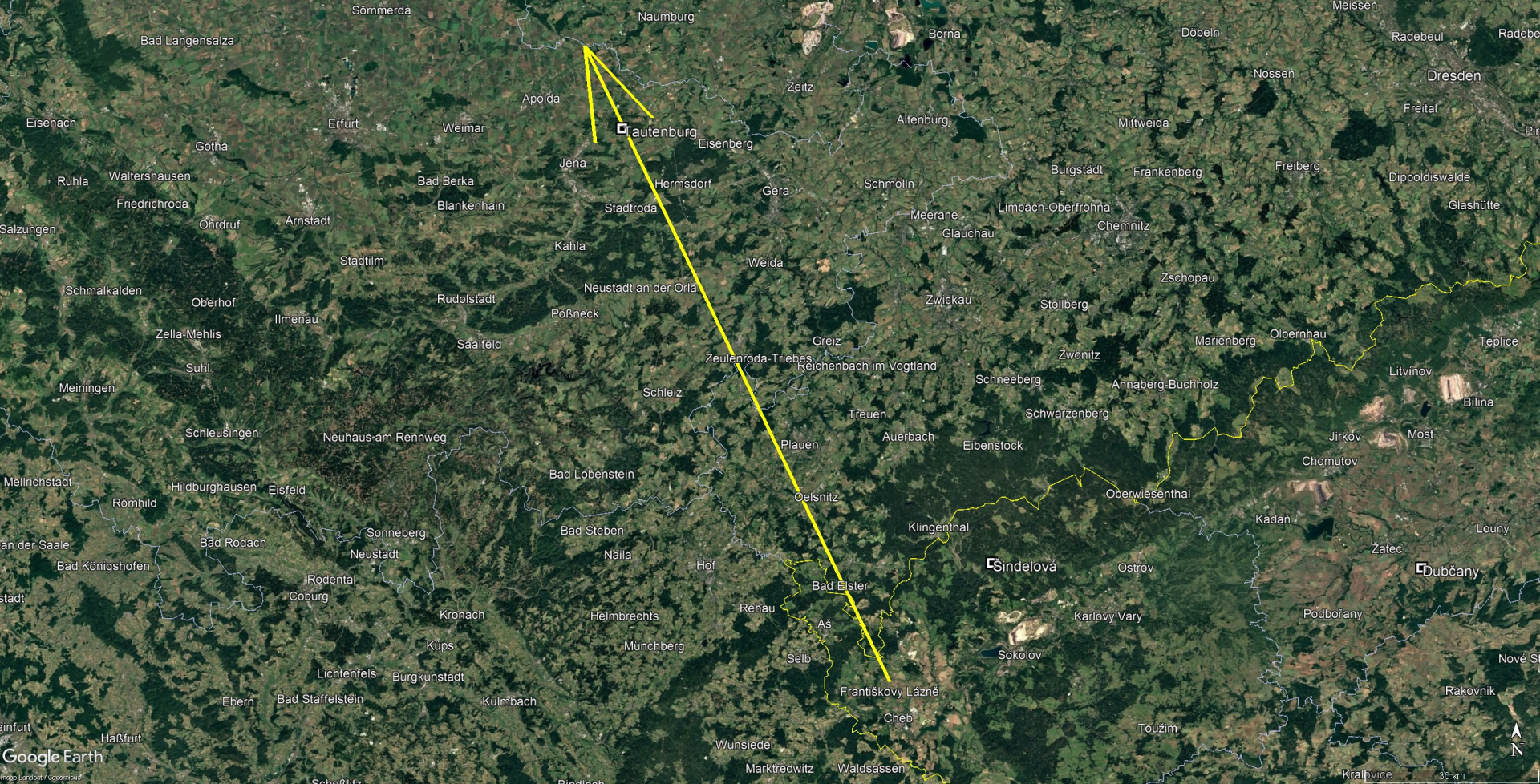 Projection of the light path of fireball EN181125_040337 in the atmosphere onto the Earth's surface (yellow arrow). The actual light path was 141 km long and the object flew it in 2 seconds. (Graphic: Astronomical Institute of the Academy of Sciences of the Czech Republic, background map: Google Earth)At 4:03:37 UTC, a small meteoroid (designated EN181125_040337) weighing only 45 grams entered the Earth's atmosphere and began to glow brightly. The object was moving at a very high speed of 70 km/s in a northwesterly direction and quickly became brighter. At its maximum brightness, the bolide reached a luminosity comparable to that of the full moon. The light trail of the bolide in the atmosphere recorded by the cameras was 141 kilometers long. After only two seconds, the bolide burned up at an altitude of 69 kilometers northwest of the observatory in Tautenburg.
Meteoroid burns up in Earth’s atmosphere
It was a body of cometary origin, which means that it is normally made of very fragile material. However, this celestial body had a slightly more solid structure than is usually the case with such cometary fireballs. Due to its small size and high speed, the original meteoroid completely disintegrated in the atmosphere and its entire original mass vaporized.
Before colliding with Earth, this meteoroid orbited the Sun on a very elongated elliptical orbit. This is typical for long-period comets. When close to the Sun, it passed between the orbits of Earth and Venus, and when far from the Sun, it passed far beyond the orbit of the last planet in our solar system, Neptune. Its orbit around the Sun took 250 years.
The Thuringian State Observatory and the Astronomical Institute of the Czech Academy of Sciences have a longstanding cooperation. They are both part of the PLATOSpec consortium.