

Astronomers at Thüringer Landessternwarte - together with a team of international researchers - have found strong evidence that the extrasolar planet GJ 436 b has a magnetic field. The evidence of magnetism on planets outside our solar system is an important step toward understanding which conditions are necessary for life to develop. A recent article in the journal "Science" explains how the researchers discovered the magnetic field.
What conditions must be in place for life to emerge on a planet? That is a central question for researchers who study exoplanets (planets orbiting stars other than the Sun). One important "ingredient" is that the planet has a magnetic field. The reason: A magnetic field ensures stable conditions, protects the atmosphere, and is therefore important for the development of life.
Astronomers do not know how many exoplanets have a magnetic field because it is very difficult to detect magnetism in planets outside our solar system. A research team led by the Instituto de Astrofísica de Andalucía (IAA-CSIS) in Granada, Spain, has now published a study that provides the first evidence that an exoplanet can directly influence its star. The results are the strongest evidence to date that an exoplanet possesses a magnetic field.
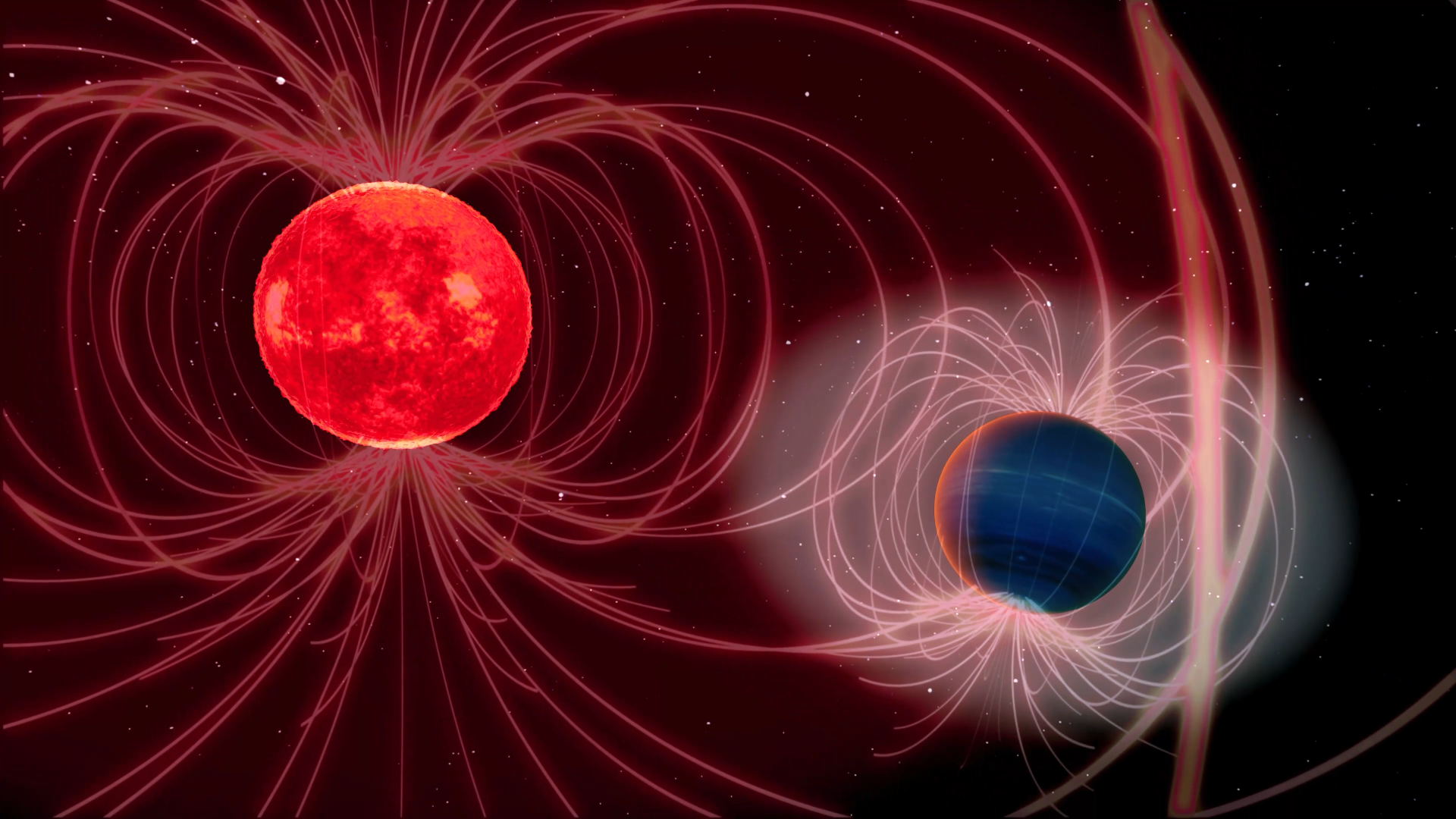 Artist's representation of the star (GJ 436) – exoplanet (GJ 436 b) interaction. Credits: IAA-CSIC/LampScienceFor the study, the research team analyzed observational data on the low-mass star GJ 436 and its planet, GJ 436 b. The Neptune-like planet orbits its star in 2.6 days along a tight orbit. "In particular, we have observed that GJ 436 b, a Neptune-like exoplanet that orbits very close to its star, causes regular changes in the brightness and energy emitted by the star at certain wavelengths," explains Daniel Revilla, a researcher at the IAA-CSIC who leads the study as part of his doctoral thesis.
Artie Hatzes, astronomer at the Thüringer Landessternwarte, and Sandra Jeffers, guest scientist at the Thüringer Landessternwarte, are among the authors. The research team analyzed over an extended period how and when these variations occur in the star. That allowed them to determine the strength of its planet's magnetic field.
Exoplanet's magnetic field affects the star's atmosphere
Whether or not a planet has a magnetic field can affect its long-term evolution. A comparison of Earth and Mars illustrates this point. Earth has a magnetic field. It acts as a protective shield against solar winds and prevents the Earth’s atmosphere from dissipating over time. Mars, on the other hand, has lost its magnetic field, causing its atmosphere to vanish. Whether a planet has a magnetic field is therefore a key factor in assessing whether life could potentially develop.
Typically, the star dominates the relationship with the planets orbiting it. However, the results of this study show that a planet can also influence its star if it orbits very close to it. The planet GJ 436 b leaves behind observable signals that allow researchers to infer the existence and strength of its magnetic field.
The planet's magnetic field transfers energy to its star
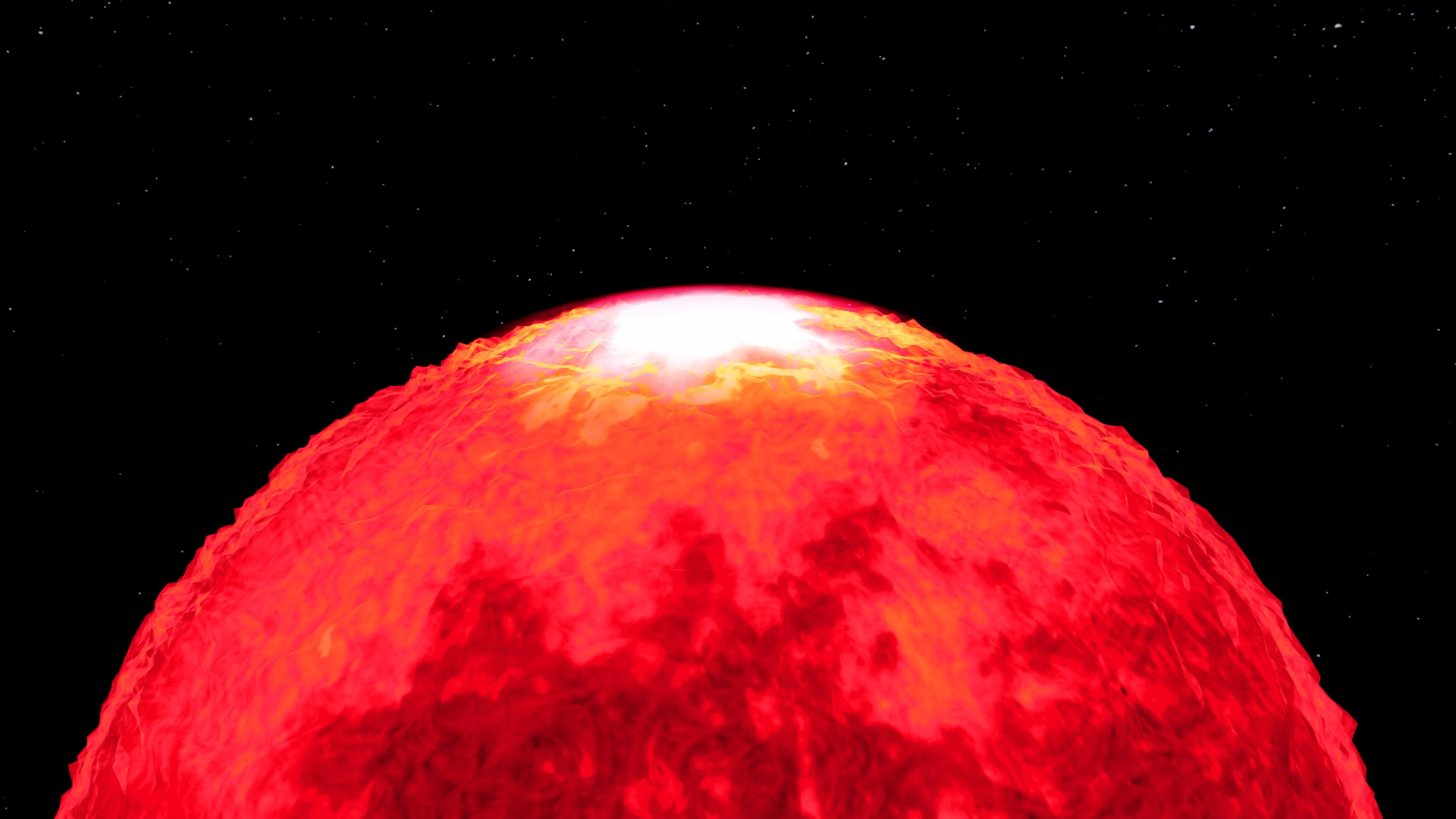 Artistic representation of the alteration in magnetic activity detected in the star GJ 436, a phenomenon similar to that which produces auroras. Credits: IAA-CSIC/LampScienceThe magnetic field of GJ 436 b interacts with that of its star and injects energy into the chromosphere, one of the upper layers of its atmosphere, increasing its activity. This process generates a phenomenon comparable to terrestrial auroras, but on a stellar scale.
The interaction between the planet and the star is not observed continuously. The phenomenon has only been detected in 2008, 2016, and 2024, three episodes separated by eight-year intervals. This periodicity coincides with the magnetic activity cycle of GJ 436, suggesting that the interaction becomes especially intense—or easier to detect—when the star goes through certain phases of its magnetic cycle. Two astronomical instruments were used for the observations: the CARMENES-Spektrograph at the Spanish Calar Alto Observatory and the HARPS-Spektrograph at the ESO 3.6-meter telescope in La Silla, Chile.
Comparing these observations with theoretical models has allowed the team to estimate a property that is extremely difficult to measure in an exoplanet: the intensity of its magnetic field. "Despite its smaller size, GJ 436 b would have a magnetic field between 2.33 and 27 times stronger than Jupiter’s," says Pedro J. Amado, co-author of the study and researcher at the IAA-CSIC.
"We model the observed interaction between the exoplanet's and the star's magnetic fields, which allows us to determine the strength of the planet's magnetic field. This is the first time this has been done for an exoplanet. That is why these results are important," explains Artie Hatzes, scientist at Thüringer Landessternwarte.
This finding opens a unique opportunity to study the magnetic fields of planets outside our solar system. Analyzing them allows us to better understand how they preserve their atmospheres and how they evolve over time. "Until now, measuring the magnetic field of an exoplanet was extremely difficult. This property is key to knowing whether a planet can protect its atmosphere and, ultimately, whether it could harbor life,” concludes Daniel Revilla.
* The team is composed of astronomers working at various Spanish research institutes, among them the Instituto de Astrofísica de Andalucía (IAA-CSIC) and the Centro de Astrobiología (CAB, CSIC-INTA), Madrid. Researchers at Thüringer Landessternwarte Tautenburg, Landessternwarte, Zentrum für Astronomie der Universität Heidelberg and the Institute for Astrophysics and Geophysics at Georg-August-Universität, Göttingen, are part of the team. Scientists from USA, Israel, Italy and Cyprus also participated.
Links
Article in "Science": "Constraining an exoplanet’s magnetic field using star-planet interactions"
Press Release, Instituto de Astrofísica de Andalucía (IAA-CSIC)