

For more than ten years, an international research team involving the universities of Hamburg, Bielefeld, Bochum and Würzburg, as well as the Thuringian State Observatory and the Jülich Computing Centre, observed the northern sky using the LOFAR radio telescope. The researchers have now presented the observational data from this sky survey and published the results in the journal "Astronomy & Astrophysics". The sky survey reveals 13.7 million cosmic radio sources and provides the most complete census yet of active galaxies.
An international team of radio astronomers led by Dr. Timothy Shimwell, scientist at ASTRON, the Netherlands Institute for Radio Astronomy, has used the LOFAR (Low Frequency Array) radio telescope to create an exceptionally detailed map of the sky. The data is now public. The survey (LOFAR Two-metre Sky Survey, LoTSS) maps the northern sky in unprecedented resolution. To create this sky map, the international research team evaluated nearly 13,000 hours of observation time with the LOFAR radio telescope. As a result, 13.7 million radio sources were recorded in a catalog. This is the largest collection of radio sources ever created.
 |
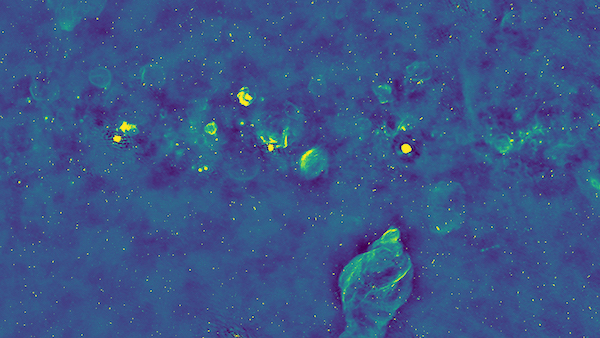 |
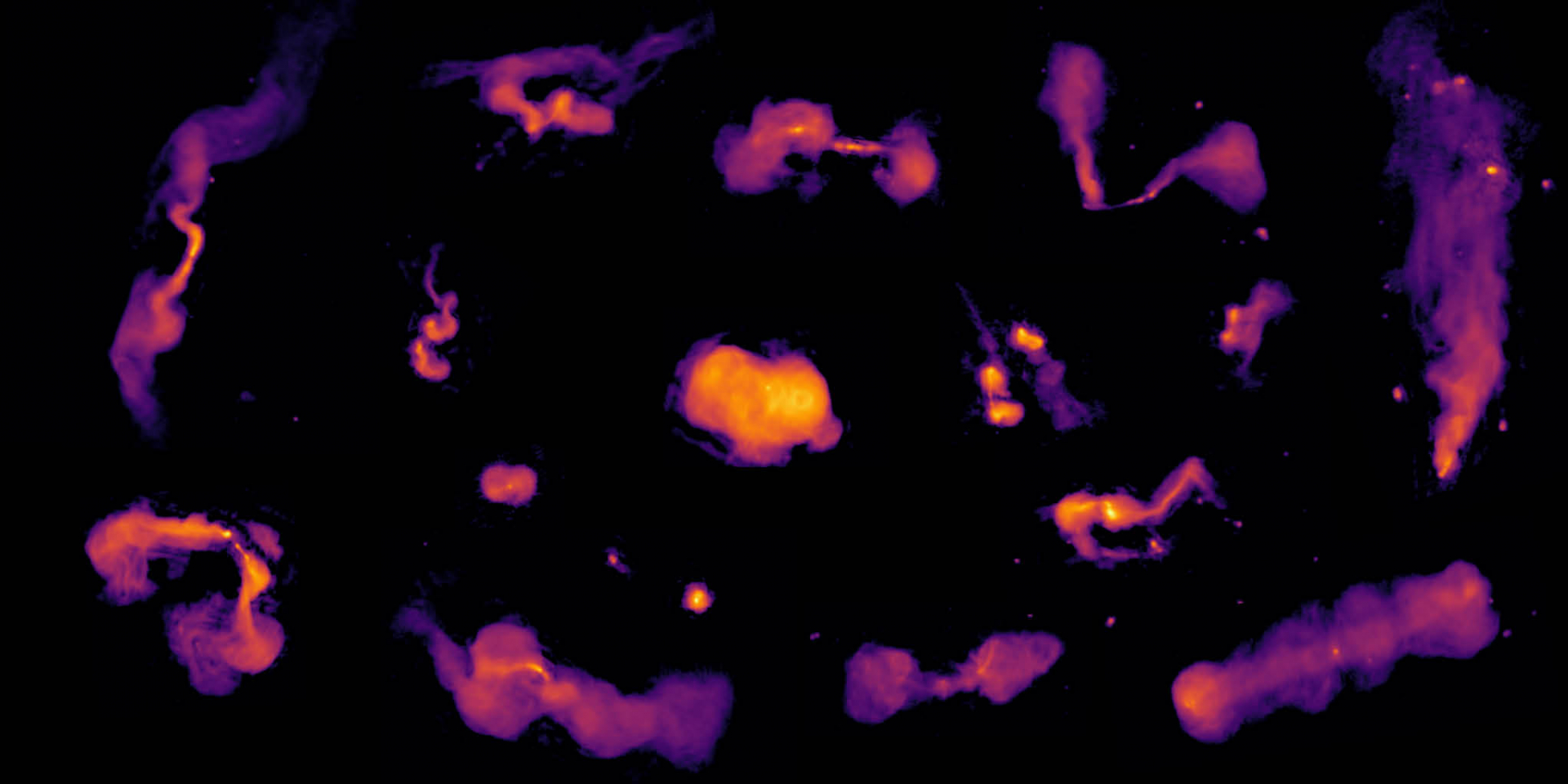
| A selection of active galaxies. The jets visible in the images are powered by supermassive black holes located at the centers of the galaxies. The image illustrates the variety of shapes that can result from the activity of black holes and their interaction with their surroundings. Credit: Maya Horton/LOFAR surveys collaboration | Here, LOFAR looks into our Galaxy toward the constellation Aquila, where many massive stars have exploded. The large Manatee Nebula (lower right) and many other bubble-like supernova remnants are visible in the image. Beyond these is a background of distant radio galaxies seen as faint points. Credit: LOFAR surveys collaboration. |
Radio telescope LOFAR detects rare and elusive objects
Observations made with a radio telescope at low frequencies reveal a completely different picture of the cosmos than observations made with optical telescopes. Radio telescopes can detect processes in the universe that remain hidden from the eye. This allows researchers to track energetic phenomena such as jets from supermassive black holes and galaxies with intense star formation.
In addition to galaxies, the survey has detected other rare and elusive objects, including merging galaxy clusters, faint supernova remnants, and active or interacting stars. The survey is already enabling hundreds of new astronomical studies. It offers fresh insights into the formation and evolution of cosmic structures, how particles are accelerated to extreme energies, and cosmic magnetic fields.
This large-scale radio map of the universe, with unprecedented depth of detail, is now publicly available. "This data release brings together more than a decade of observations, large-scale data processing and scientific analysis by an international research team,” says Dr. Timothy Shimwell, lead author and astronomer at ASTRON and Leiden University, Netherlands.
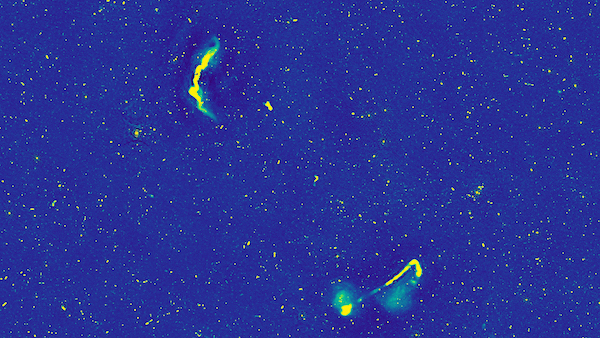 The radio galaxies NGC 315 and NGC 383 dominate this image with spectacular, twisted jets powered by central supermassive black holes. Located about 223 and 209 million light-years away, they stand out against a background of hundreds of far more distant radio galaxies, seen mostly as faint points. Credit: LOFAR surveys collaboration“LOFAR allows us to study cosmic magnetic fields in detail. In doing so, we have discovered that shock waves can accelerate tiny particles very efficiently. These observations are only possible thanks to LOFAR's special capabilities,” says Marcus Brüggen, Professor of Astrophysics at the University of Hamburg. “In addition to insights into the detailed physical processes, the new sky atlas also teaches us how galaxies evolve and how they are arranged in the universe,” adds Dominik Schwarz, Professor of Physics at Bielefeld University.
Enormous challenges for software development and data processing
The research team developed complex software to map the details of the radio sources. One major challenge was to precisely correct for distortions caused by the constantly changing ionosphere (the electrically charged layer of the upper atmosphere). The workflows for processing the 13,000 hours of observations had to be highly automated.
Distributing the computing load across multiple supercomputers and storing and retrieving such huge amounts of data posed further challenges. “The volume of data we handled - 18.6 petabytes in total - was immense and required continuous processing and monitoring over many years, using more than 20 million core hours of computing time,” says Dr. Alexander Drabent, scientist and software developer for LOFAR at the Thuringian State Observatory.
JUWELS, one of Europe's fastest supercomputers, was used for data analysis at Forschungszentrum Jülich. “For this sky survey, such large amounts of data had to be stored, processed, and made accessible for the first time as part of an astronomical observation project. LOFAR has thus paved the way for future large-scale projects,” says Cristina Manzano, Head of Operation & Development Team (ODT) Technical Services at the Jülich Supercomputing Centre (JSC).
Looking forward
LOFAR has been organized as a European Research Infrastructure Consortium (LOFAR ERIC) since 2024. Member states include the Netherlands and the Federal Republic of Germany. Research institutes in Germany operate six of the international LOFAR stations. The network continues to grow: New LOFAR stations are being built in Italy and Bulgaria. In 2025, the Czech Republic joined LOFAR ERIC, and a new station is also being built there.
The LOFAR radio telescope is currently being modernized. The data from the recently published “LOFAR Two-meter Sky Survey” will provide scientists with plenty of material for astronomical discoveries in the coming years. It will now be carefully searched for rare astrophysical phenomena.
Publication
"The LOFAR Two-metre Sky Survey VII. Third Data Release",
T.W. Shimwell et al., Astronomy & Astrophysics
DOI: 10.1051/0004-6361/202557749
Technical Details
Sky Coverage: 19,035 square degrees (including 88% of the northern sky)
Sources Catalogued: 13,667,877
Frequency Range: 120-168 MHz (wavelength ~2 meters)
Angular Resolution: 6 arcseconds (9" below declination 10°)
Median Sensitivity: 92 µJy/beam
Data Volume: 18.6 petabytes processed; 590 TB final products
Observation Time: 12,950 hours over 10.5 years
Processing Power: ~20 million core hours
Data Access
All LoTSS-DR3 data products are publicly available, including images and catalogues covering 19,035 square degrees (46% of the sky), polarization information, calibrated visibility data, and 590 terabytes of final products. These are available through:
https://lofar-surveys.org/dr3.html
https://doi.org/10.25606/SURF.lotss-dr3
About LOFAR-ERIC
The LOw Frequency ARray (LOFAR) is a revolutionary radio telescope developed and built by the Dutch Institute for Radio Astronomy ASTRON. Unlike conventional parabolic antennas, LOFAR consists of thousands of simple antenna elements distributed across Europe and connected via fiber optic networks. The data from all antennas is combined using powerful computers to create images of the radio sky.
LOFAR is operated by the LOFAR European Research Infrastructure Consortium (LOFAR ERIC), an association of institutions from eleven countries (the Netherlands, Bulgaria, Germany, France, Great Britain, Ireland, Italy, Latvia, Poland, Sweden, and the Czech Republic). LOFAR ERIC is an excellent example of successful international scientific cooperation: institutions in different countries pool their expertise, computing power, and research infrastructure across national borders to deepen humanity's knowledge of the origins of our universe.
The international LOFAR telescope is unique due to its sensitivity, large field of view, and image resolution and clarity. The LOFAR data archive is the largest astronomical data collection in the world to date.
Astronomical Research with LOFAR in Germany
The data from the LOFAR sky survey are of great importance for German astronomy. They are used in research networks such as the Cluster of Excellence “Quantum Universe,” the Collaborative Research Center 1491 “Cosmic Interacting Matters - From Source to Signal,” and the DFG Research Group FOR 5195 “Relativistic Jets in Active Galaxies.” The Federal Ministry of Education and Research (BMFTR) is funding the development of LOFAR as part of the joint project 05A2023: “LOFAR: New possibilities and new structure for the leading low-frequency radio telescope.” Six universities (Bielefeld, Bochum, Dortmund, Erlangen-Nuremberg, Hamburg, and Würzburg) as well as the Forschungszentrum Jülich, the Leibniz Institute for Astrophysics Potsdam, the Max Planck Institute for Astrophysics in Garching, the Max Planck Institute for Radio Astronomy in Bonn, and the Thuringian State Observatory in Tautenburg are involved in the operation of the six German LOFAR stations.
Links
LOFAR in Germany
www.glowconsortium.de
LOFAR ERIC
www.lofar.eu
LOFAR on the ASTRON web site
https://science.astron.nl/telescopes/lofar/