

An international research team has discovered a celestial system of a type never before observed: a companion orbits a brown dwarf, which in turn orbits a young star. The CRIRES+ instrument and the “viper” software were used to discover this system. Thüringer Landessternwarte is involved in both projects.
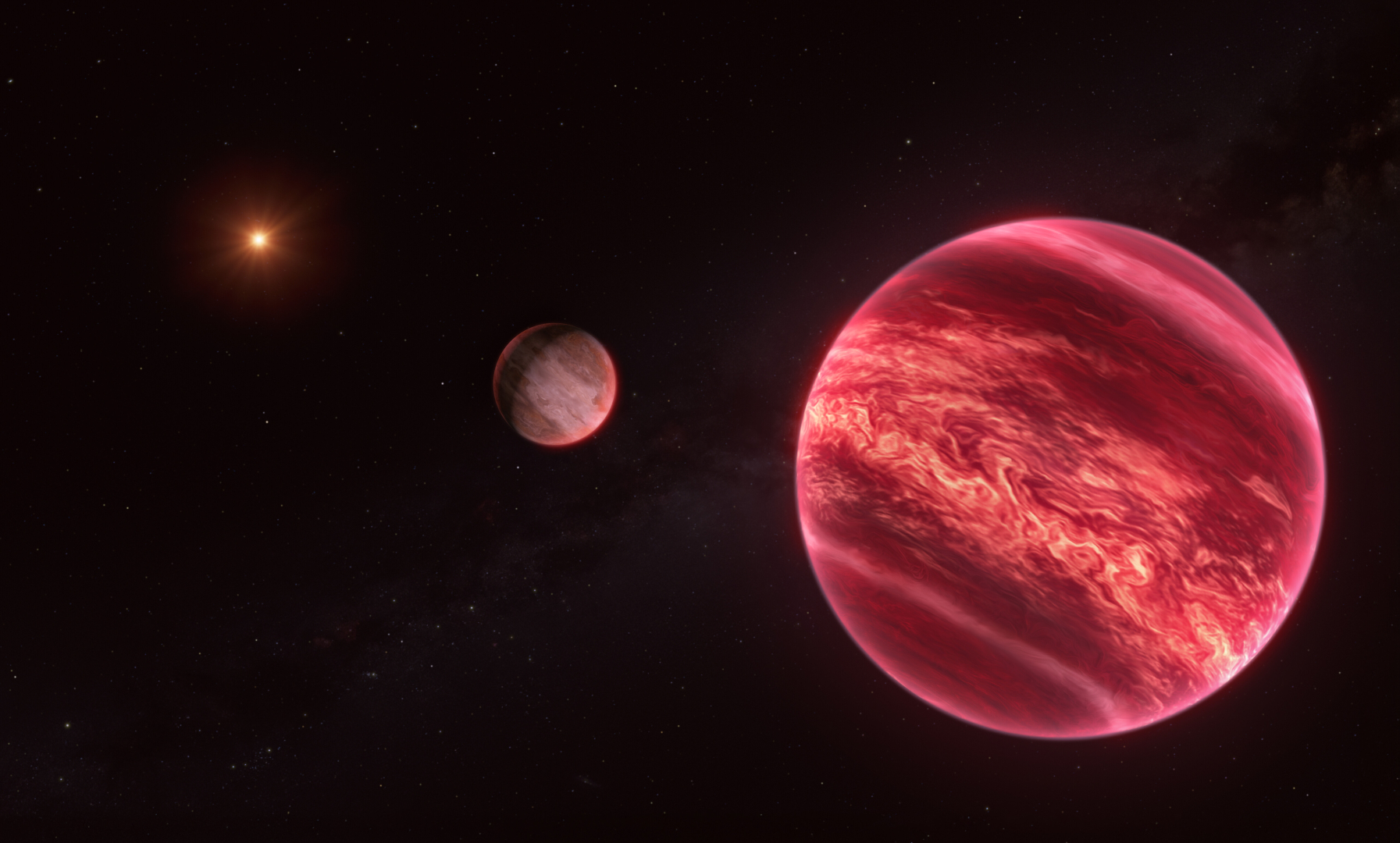 This illustration shows the system around the star CD-35 2722, with the newly found moon-like object at the centre. The star –– the point source to the left –– has about half the mass of our Sun, and it is orbited by a brown dwarf, the reddish-brown object seen here in the foreground (right). The brown dwarf has about 37 times the mass of Jupiter: too massive to be a planet, but not massive enough to have sustained nuclear fusion like stars. This brown dwarf is, in turn, orbited by a newly discovered object at least as massive as Jupiter, seen at the centre of this image. Credit: ESO/M. KornmesserThe discovery is so recent that there is not yet a defined name for the celestial object. An international research team* has detected a companion orbiting a brown dwarf in the CD-35 2722 system. The brown dwarf, in turn, orbits a young star, which is the largest and most massive object in this system. Kevin Hoy, ESO student in Chile, is the lead author of a "Nature" article describing the newly found system.
Brown dwarfs are neither a planet nor a star. They are not massive enough to become true stars, but too massive to be classified as planets. The brown dwarf CD-35 2722 B has more than 30 times the mass of Jupiter. However, its radius is only 1.5 times that of Jupiter.
The research team refers to the moon-like object orbiting the brown dwarf as an “exosatellite.” Whether a companion orbiting a brown dwarf can be called an ‘exomoon’ remains an open question, as the term “exomoon” is not clearly defined. Do only companions orbiting planets count as moons, or do those orbiting brown dwarfs also qualify? To date, more than 6,000 exoplanets (planets orbiting stars other than our Sun) have been detected, but no exomoon has yet been found orbiting an exoplanet.
Jana Köhler, scientist and software specialist at the Thuringian State Observatory, made an important contribution to this research finding by analyzing the data. Köhler explains why the detection of the exosatellite orbiting the brown dwarf is special: “Companions to brown dwarfs have been discovered before. However, those were isolated brown dwarfs and not, as in this case, a brown dwarf orbiting a star. Furthermore, in previously known systems, brown dwarfs and their companions have a similar mass ratio, so that they more closely resemble a binary star system.” For the first time, researchers have now succeeded in identifying a less massive companion in a brown dwarf–star binary system. The mass of the exosatellite is only 2.5 percent of the brown dwarf’s mass.
Measurement accuracy has not been good enough so far
Until now, the necessary precision for such measurements had not been achieved. It was only through the combination of a large telescope - in this case, the Very Large Telescope at the Paranal Observatory of the European Southern Observatory (ESO) in Chile-, the CRIRES+ spectrograph for observations in the near-infrared range, and the viper data-processing software that the necessary precision was achieved to prove that the brown dwarf has a companion.
“Brown dwarfs shine much more brightly in the near-infrared than in the optical wavelength range. In addition, the Very Large Telescope has very high resolution. That is why the CRIRES+ infrared spectrograph on the Very Large Telescope was exactly the right instrument that enabled us to observe the brown dwarf separately from its star,” Köhler explains. Thüringer Landessternwarte had an important part in building the spectrograph CRIRES+.
The strength of the viper (Velocity and IP EstimatoR) software, in turn, lies in its ability to correct for instrumental variations and the telluric absorption lines of the Earth’s atmosphere. Telluric lines are absorption lines in the observation spectrum caused by molecules in the Earth’s atmosphere. They do not originate from the observed celestial object and must be “factored out” of the observations. “Dealing with these telluric lines poses a major challenge in all near-infrared observations. viper offers a simple and fast solution to this problem, thereby enabling highly accurate measurements of radial velocities,” explains Köhler.
Radial velocity measurements detect the periodic shift in the star's absorption lines. This information can be used to determine whether a celestial object has a companion.
Exosatellite orbits the brown dwarf in 170 days
The research team took a closer look at the brown dwarf’s newly discovered companion. It takes about 170 days to orbit the brown dwarf at a distance of 0.2 astronomical units. An astronomical unit is defined as the distance between the Sun and Earth. The exosatellite’s mass is approximately 0.9 Jupiter masses.
The discovery of this exosatellite will advance exoplanet research. There are already a number of theories regarding the formation of planets. Observations such as the exosatellite now presented can help to support and refine these models. The research paper, “Planetary-Mass Exosatellite Detected Around a Star’s Substellar Companion,” has been published in the journal "Nature".
* The team is composed of K. Hoy (Instituto de Estudios Astrofísicos, Facultad de Ingeniería y Ciencias, Universidad Diego Portales, Chile [Diego Portales]; European Southern Observatory, Chile [ESO Chile]; Millennium Nucleus on Young Exoplanets and their Moons, Chile [YEMS]), A. Zurlo (Diego Portales; YEMS), P. A. Peña R. (Diego Portales; Centro de Astrofísica y Tecnologías Afines, Chile [CATA]), J. Köhler (TLS Tautenburg, Germany), S. Desidera (INAF Osservatorio Astronomico di Padova, Italy [INAF Padova]), R. Gratton (INAF Padova), C. Lazzoni (INAF Padova; YEMS), S. Petrus (NASA Goddard Space Flight Center, USA; YEMS), F. Rodler (ESO Chile), J. Smoker (ESO Chile), V. D’Orazi (Dipartimento di Fisica, Università degli Studi di Roma Tor Vergata, Italy; INAF Osservatorio Astronomico di Roma, Italy), I. Carleo (INAF Padova), I. Giovannini (Dipartimento di Fisica e Astronomia, Università degli Studi di Padova, Italy; Diego Portales; INAF Padova; YEMS).
About Thüringer Landessternwarte
The Thuringian State Observatory Tautenburg (TLS) is a research institution of the Free State of Thuringia. With its 2-meter Alfred Jensch Telescope for observations in the optical spectral range, a station of the European Low Frequency Array (LOFAR) radio telescope, and the Tautenburg Solar Laboratory (TauSoL), it conducts basic research in astrophysics. The astronomers at the TLS also conduct observations using major international telescopes around the world.
www.tls-tautenburg.de
Links:
Article in "Nature": "Planetary-Mass Exosatellite Detected Around a Star’s Substellar Companion”
Article "Satellite Detected Around a Star’s Substellar Companion”
ESO press release with pictures and video