

Astrophysicist at Thüringer Landessternwarte is part of the team that discovered a socalled "exomoon"
23.07.2026
An international research team has discovered a celestial system of a type never before observed: a companion orbits a brown dwarf, which in turn orbits a young star. The CRIRES+ instrument and the “viper” software were used to discover this system. Thüringer Landessternwarte is involved in both projects.
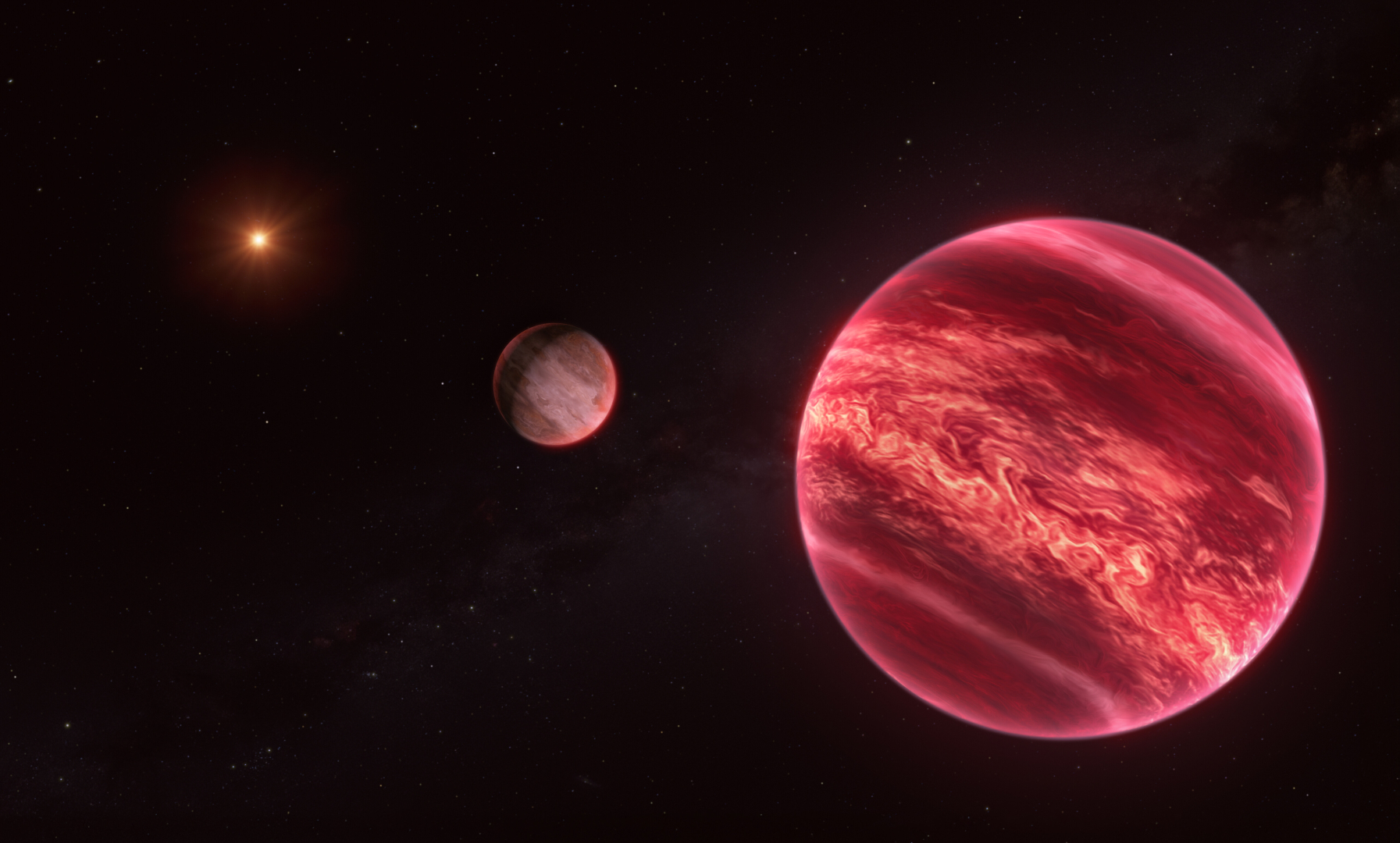 This illustration shows the system around the star CD-35 2722, with the newly found moon-like object at the centre. The star –– the point source to the left –– has about half the mass of our Sun, and it is orbited by a brown dwarf, the reddish-brown object seen here in the foreground (right). The brown dwarf has about 37 times the mass of Jupiter: too massive to be a planet, but not massive enough to have sustained nuclear fusion like stars. This brown dwarf is, in turn, orbited by a newly discovered object at least as massive as Jupiter, seen at the centre of this image. Credit: ESO/M. KornmesserThe discovery is so recent that there is not yet a defined name for the celestial object. An international research team* has detected a companion orbiting a brown dwarf in the CD-35 2722 system. The brown dwarf, in turn, orbits a young star, which is the largest and most massive object in this system. Kevin Hoy, ESO student in Chile, is the lead author of a "Nature" article describing the newly found system.
Brown dwarfs are neither a planet nor a star. They are not massive enough to become true stars, but too massive to be classified as planets. The brown dwarf CD-35 2722 B has more than 30 times the mass of Jupiter. However, its radius is only 1.5 times that of Jupiter.
The research team refers to the moon-like object orbiting the brown dwarf as an “exosatellite.” Whether a companion orbiting a brown dwarf can be called an ‘exomoon’ remains an open question, as the term “exomoon” is not clearly defined. Do only companions orbiting planets count as moons, or do those orbiting brown dwarfs also qualify? To date, more than 6,000 exoplanets (planets orbiting stars other than our Sun) have been detected, but no exomoon has yet been found orbiting an exoplanet.
Jana Köhler, scientist and software specialist at the Thuringian State Observatory, made an important contribution to this research finding by analyzing the data. Köhler explains why the detection of the exosatellite orbiting the brown dwarf is special: “Companions to brown dwarfs have been discovered before. However, those were isolated brown dwarfs and not, as in this case, a brown dwarf orbiting a star. Furthermore, in previously known systems, brown dwarfs and their companions have a similar mass ratio, so that they more closely resemble a binary star system.” For the first time, researchers have now succeeded in identifying a less massive companion in a brown dwarf–star binary system. The mass of the exosatellite is only 2.5 percent of the brown dwarf’s mass.
Measurement accuracy has not been good enough so far
Until now, the necessary precision for such measurements had not been achieved. It was only through the combination of a large telescope - in this case, the Very Large Telescope at the Paranal Observatory of the European Southern Observatory (ESO) in Chile-, the CRIRES+ spectrograph for observations in the near-infrared range, and the viper data-processing software that the necessary precision was achieved to prove that the brown dwarf has a companion.
“Brown dwarfs shine much more brightly in the near-infrared than in the optical wavelength range. In addition, the Very Large Telescope has very high resolution. That is why the CRIRES+ infrared spectrograph on the Very Large Telescope was exactly the right instrument that enabled us to observe the brown dwarf separately from its star,” Köhler explains. Thüringer Landessternwarte had an important part in building the spectrograph CRIRES+.
The strength of the viper (Velocity and IP EstimatoR) software, in turn, lies in its ability to correct for instrumental variations and the telluric absorption lines of the Earth’s atmosphere. Telluric lines are absorption lines in the observation spectrum caused by molecules in the Earth’s atmosphere. They do not originate from the observed celestial object and must be “factored out” of the observations. “Dealing with these telluric lines poses a major challenge in all near-infrared observations. viper offers a simple and fast solution to this problem, thereby enabling highly accurate measurements of radial velocities,” explains Köhler.
Radial velocity measurements detect the periodic shift in the star's absorption lines. This information can be used to determine whether a celestial object has a companion.
Exosatellite orbits the brown dwarf in 170 days
The research team took a closer look at the brown dwarf’s newly discovered companion. It takes about 170 days to orbit the brown dwarf at a distance of 0.2 astronomical units. An astronomical unit is defined as the distance between the Sun and Earth. The exosatellite’s mass is approximately 0.9 Jupiter masses.
The discovery of this exosatellite will advance exoplanet research. There are already a number of theories regarding the formation of planets. Observations such as the exosatellite now presented can help to support and refine these models. The research paper, “Planetary-Mass Exosatellite Detected Around a Star’s Substellar Companion,” has been published in the journal "Nature".
* The team is composed of K. Hoy (Instituto de Estudios Astrofísicos, Facultad de Ingeniería y Ciencias, Universidad Diego Portales, Chile [Diego Portales]; European Southern Observatory, Chile [ESO Chile]; Millennium Nucleus on Young Exoplanets and their Moons, Chile [YEMS]), A. Zurlo (Diego Portales; YEMS), P. A. Peña R. (Diego Portales; Centro de Astrofísica y Tecnologías Afines, Chile [CATA]), J. Köhler (TLS Tautenburg, Germany), S. Desidera (INAF Osservatorio Astronomico di Padova, Italy [INAF Padova]), R. Gratton (INAF Padova), C. Lazzoni (INAF Padova; YEMS), S. Petrus (NASA Goddard Space Flight Center, USA; YEMS), F. Rodler (ESO Chile), J. Smoker (ESO Chile), V. D’Orazi (Dipartimento di Fisica, Università degli Studi di Roma Tor Vergata, Italy; INAF Osservatorio Astronomico di Roma, Italy), I. Carleo (INAF Padova), I. Giovannini (Dipartimento di Fisica e Astronomia, Università degli Studi di Padova, Italy; Diego Portales; INAF Padova; YEMS).
About Thüringer Landessternwarte
The Thuringian State Observatory Tautenburg (TLS) is a research institution of the Free State of Thuringia. With its 2-meter Alfred Jensch Telescope for observations in the optical spectral range, a station of the European Low Frequency Array (LOFAR) radio telescope, and the Tautenburg Solar Laboratory (TauSoL), it conducts basic research in astrophysics. The astronomers at the TLS also conduct observations using major international telescopes around the world.
www.tls-tautenburg.de
Links:
Article in "Nature": "Planetary-Mass Exosatellite Detected Around a Star’s Substellar Companion”
Article "Satellite Detected Around a Star’s Substellar Companion”
ESO press release with pictures and video
Astronomers find strong evidence of a magnetic field on the exoplanet GJ 436 b
30.06.2026
Astronomers at Thüringer Landessternwarte - together with a team of international researchers - have found strong evidence that the extrasolar planet GJ 436 b has a magnetic field. The evidence of magnetism on planets outside our solar system is an important step toward understanding which conditions are necessary for life to develop. A recent article in the journal "Science" explains how the researchers discovered the magnetic field.
What conditions must be in place for life to emerge on a planet? That is a central question for researchers who study exoplanets (planets orbiting stars other than the Sun). One important "ingredient" is that the planet has a magnetic field. The reason: A magnetic field ensures stable conditions, protects the atmosphere, and is therefore important for the development of life.
Astronomers do not know how many exoplanets have a magnetic field because it is very difficult to detect magnetism in planets outside our solar system. A research team led by the Instituto de Astrofísica de Andalucía (IAA-CSIS) in Granada, Spain, has now published a study that provides the first evidence that an exoplanet can directly influence its star. The results are the strongest evidence to date that an exoplanet possesses a magnetic field.
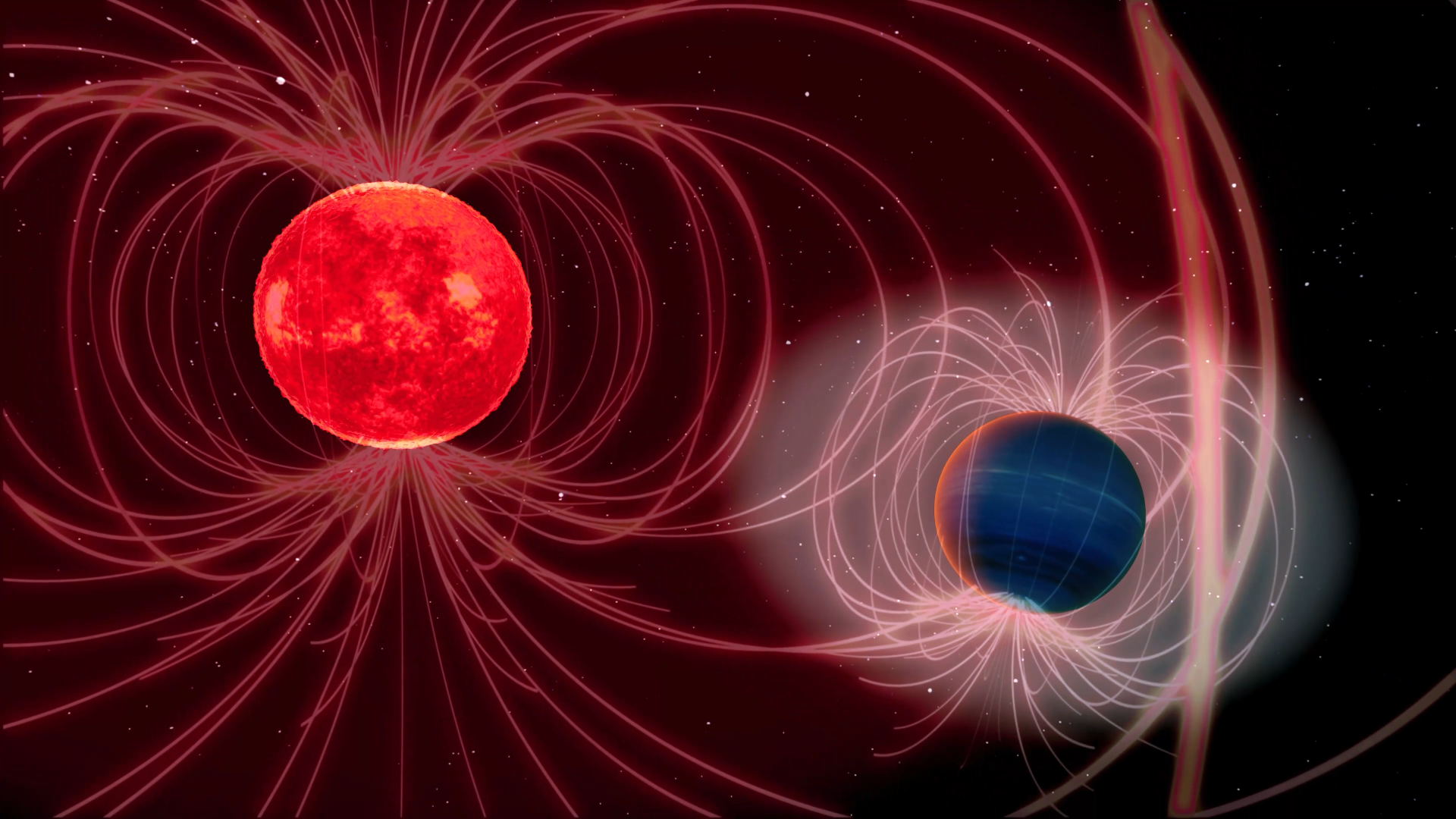 Artist's representation of the star (GJ 436) – exoplanet (GJ 436 b) interaction. Credits: IAA-CSIC/LampScienceFor the study, the research team analyzed observational data on the low-mass star GJ 436 and its planet, GJ 436 b. The Neptune-like planet orbits its star in 2.6 days along a tight orbit. "In particular, we have observed that GJ 436 b, a Neptune-like exoplanet that orbits very close to its star, causes regular changes in the brightness and energy emitted by the star at certain wavelengths," explains Daniel Revilla, a researcher at the IAA-CSIC who leads the study as part of his doctoral thesis.
Artie Hatzes, astronomer at the Thüringer Landessternwarte, and Sandra Jeffers, guest scientist at the Thüringer Landessternwarte, are among the authors. The research team analyzed over an extended period how and when these variations occur in the star. That allowed them to determine the strength of its planet's magnetic field.
Exoplanet's magnetic field affects the star's atmosphere
Whether or not a planet has a magnetic field can affect its long-term evolution. A comparison of Earth and Mars illustrates this point. Earth has a magnetic field. It acts as a protective shield against solar winds and prevents the Earth’s atmosphere from dissipating over time. Mars, on the other hand, has lost its magnetic field, causing its atmosphere to vanish. Whether a planet has a magnetic field is therefore a key factor in assessing whether life could potentially develop.
Typically, the star dominates the relationship with the planets orbiting it. However, the results of this study show that a planet can also influence its star if it orbits very close to it. The planet GJ 436 b leaves behind observable signals that allow researchers to infer the existence and strength of its magnetic field.
The planet's magnetic field transfers energy to its star
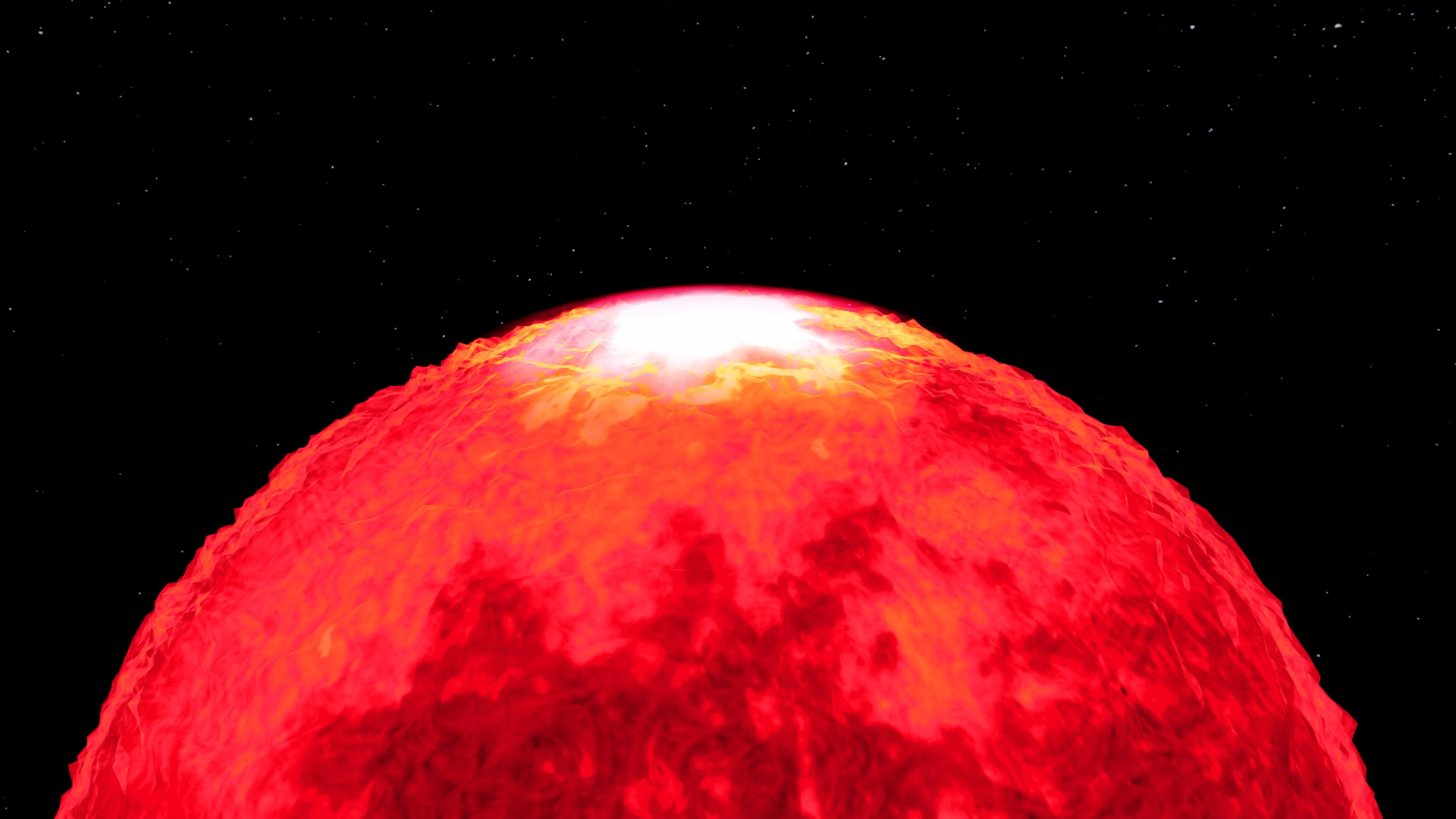 Artistic representation of the alteration in magnetic activity detected in the star GJ 436, a phenomenon similar to that which produces auroras. Credits: IAA-CSIC/LampScienceThe magnetic field of GJ 436 b interacts with that of its star and injects energy into the chromosphere, one of the upper layers of its atmosphere, increasing its activity. This process generates a phenomenon comparable to terrestrial auroras, but on a stellar scale.
The interaction between the planet and the star is not observed continuously. The phenomenon has only been detected in 2008, 2016, and 2024, three episodes separated by eight-year intervals. This periodicity coincides with the magnetic activity cycle of GJ 436, suggesting that the interaction becomes especially intense—or easier to detect—when the star goes through certain phases of its magnetic cycle. Two astronomical instruments were used for the observations: the CARMENES-Spektrograph at the Spanish Calar Alto Observatory and the HARPS-Spektrograph at the ESO 3.6-meter telescope in La Silla, Chile.
Comparing these observations with theoretical models has allowed the team to estimate a property that is extremely difficult to measure in an exoplanet: the intensity of its magnetic field. "Despite its smaller size, GJ 436 b would have a magnetic field between 2.33 and 27 times stronger than Jupiter’s," says Pedro J. Amado, co-author of the study and researcher at the IAA-CSIC.
"We model the observed interaction between the exoplanet's and the star's magnetic fields, which allows us to determine the strength of the planet's magnetic field. This is the first time this has been done for an exoplanet. That is why these results are important," explains Artie Hatzes, scientist at Thüringer Landessternwarte.
This finding opens a unique opportunity to study the magnetic fields of planets outside our solar system. Analyzing them allows us to better understand how they preserve their atmospheres and how they evolve over time. "Until now, measuring the magnetic field of an exoplanet was extremely difficult. This property is key to knowing whether a planet can protect its atmosphere and, ultimately, whether it could harbor life,” concludes Daniel Revilla.
* The team is composed of astronomers working at various Spanish research institutes, among them the Instituto de Astrofísica de Andalucía (IAA-CSIC) and the Centro de Astrobiología (CAB, CSIC-INTA), Madrid. Researchers at Thüringer Landessternwarte Tautenburg, Landessternwarte, Zentrum für Astronomie der Universität Heidelberg and the Institute for Astrophysics and Geophysics at Georg-August-Universität, Göttingen, are part of the team. Scientists from USA, Israel, Italy and Cyprus also participated.
Links
Article in "Science": "Constraining an exoplanet’s magnetic field using star-planet interactions"
Press Release, Instituto de Astrofísica de Andalucía (IAA-CSIC)
Save the Date: Long Night of the Stars at Thüringer Landessternwarte on October 3, 2026
22.06.2026
Experience astronomical research and see the starry sky from a new perspective during the “Long Night of the Stars” at the Thüringer Landessternwarte in Tautenburg on October 3, 2026. This free event features many highlights: Visitors can tour a station of LOFAR, the world’s largest radio telescope, and learn how it is used to study distant galaxies. You’ll get to know the Tautenburg Solar Laboratory, where a prototype for continuous observation of the Sun is being developed. And you’ll have the opportunity to see our 2-meter Alfred Jensch optical telescope in action. Visitors can observe celestial objects themselves using portable telescopes -- weather permitting.
The DLR_School_Lab Jena will be joining us and engaging children and teens with a variety of activities: Our young visitors can examine tiny pieces of a meteorite under a microscope, make constellation crafts, and take part in exciting space-themed experiments.
The Long Night of the Stars begins on October 2, 2026, at 5 p.m. and lasts until midnight. Visitors can look forward to a varied and entertaining program featuring exciting lectures, interesting guided tours, and fascinating stargazing sessions.
Talks and Presentations
The lectures explore a wide variety of phenomena in the universe, such as: What does the Sun have to do with space weather and the aurora? What happens when one star accretes mass from another star? Are Earth-like planets as common as sand on the beach? The talks are in German. There will be one talk in English at 8.30 pm.
| When? | Topic | |
| 17.30 Uhr bis 18.00 Uhr | Die Sonne - der Stern mit dem wir leben | Prof. Dr. Markus Roth |
| 18.30 Uhr bis 19.00 Uhr | Das Universum, beobachtet mit Radiowellen – oder: Von Schwarzen Löchern und kosmischen Kollisionen | Prof. Dr. Matthias Hoeft |
| 19.30 Uhr bis 20.00 Uhr | Polarlicht – the Beauty and the Beast | Dr. Jochen Eislöffel |
| 20.30 Uhr bis 21.00 Uhr | Stellar beats: the music of the cosmos (Vortrag auf Englisch) | Aashana Tripathi |
| 21.30 Uhr bis 22.00 Uhr | Kannibalismus im Weltall: Wenn Doppelsterne zu Novae werden | Dr. habil. Veronika Schaffenroth |
| 22:30 Uhr bis 23.00 Uhr | Gibt es Erden wie Sand am Meer? | Dr. Eike Guenther |
Location: All presentations will take place in the seminar room on the top floor of the administration building (“Neubau”).
Please pick up your free ticket for a presentation in advance at the information desk.
Visit the 2-Meter-Alfred-Jensch-Telescope
From 5:30 p.m. to 11:30 p.m., guided tours of the 2-meter Alfred Jensch Telescope will be offered every half hour. During the tour live images from the telescope will be displayed. The first three tours are specifically for children.
To manage the flow of visitors into the dome, admission tickets for the guided tours will be available outside the dome. This will allow as many people as possible to participate in a tour of the dome while ensuring that no more than 70 visitors are inside the dome at any one time.
More Highlights
If the sky is clear, we and our colleagues from the Volkssternwarte Urania Jena e.V. will set up telescopes behind the dome building so that visitors can take a look at planets and other celestial objects for themselves.
We’ll also be exploring the night sky with the naked eye. At 8 p.m., 9 p.m., and 10 p.m., astronomers will be explaining constellations on the lawn behind the dome. This is a great opportunity for anyone who wants to learn more about the wonders of the night sky. The dark sky above Tautenburg is perfect for this! Let’s keep our fingers crossed that it won’t be cloudy or rainy!
We’ll explain live observations using our LOFAR radio telescope, demonstrate how observations are conducted at the Tautenburg Solar Laboratory, and describe the goals of solar research in Tautenburg.
A few practical tips
- Admission to the Long Night of the Stars is free; no advance registration is required.
- The dome and the grounds are not wheelchair accessible.
- Please dress appropriately for the season and the weather. You’ll appreciate warm clothing, especially inside the dome building, but also when observing the sky outdoors.
- Please pick up your free ticket for the tour of the Alfred Jensch Telescope in front of the dome building. We are delighted that so many people are interested in touring the telescope. Please be prepared that you may have to wait a short while before your guided tour begins.
- Please pick up a free ticket for the talks at the information booth across from the administration building. This will help us better coordinate the flow of visitors and ensure that everything runs smoothly, so that as many guests as possible can attend a talk. Thank you very much for your cooperation!
- Refreshments will be available on the observatory grounds so you can enjoy a bite to eat before or after stargazing.
We look forward to seeing you on October 3, 2026!
First Light for the new Tautenburg Faint Object Spectrograph
19.05.2026
A new spectrograph was put into operation at the 2 meter Alfred Jensch telescope. At the end of April 2026, the workshop staff and the instrumentation team at the Thüringer Landessternwarte installed TauFOS, the Tautenburg Faint Object Spectrograph, together with a new front end. During the first few days of operation, numerous tests were conducted and initial scientific data was already collected.
The front end and the new spectrograph are the first components of our ongoing effort to modernize the optical telescope's spectroscopic instrumentation. Both were financed by the Free State of Thuringia.
TauFOS was primarily developed to study close binary star systems consisting of hot dwarf stars. These faint objects, with orbital periods of only a few hours, emit mainly blue or ultraviolet light. For this reason, the new instrument was designed to cover the blue spectral range from 370 to 540 nanometers with medium resolution (approx. 0.15 nanometers) and with the highest possible efficiency.
Fiber-optic coupling makes telescope use more flexible
The new front end serves as the interface between the optical telescope's Nasmyth focus and the spectrograph. What makes it special is that it features very fast active image stabilization to compensate for tracking errors of the telescope as well as "image jitter" caused by atmospheric turbulence. In addition, the new front end guides the starlight via a fiber optic cable to the spectrograph. This allows for much more precise wavelength calibration, which is important for the instrument’s intended use. It also makes it easy to switch between multiple fiber-coupled instruments. This makes the telescope’s overall use more flexible.
The "First Light" campaign is still ongoing. "First Light" refers to the initial test observations made by an observational instrument. Hans-Peter Doerr is responsible at Thüringer Landessternwarte for the development and construction of the two devices. He reports that the installation and commissioning went smoothly: „We were lucky to have many clear nights for testing and first scientific observations. So far, we are very satisfied with the data quality and the system performance, which fully meet our scientific requirements and in some cases even exceed our expectations.“
Instruments have been designed and built at the observatory
TauFOS and the front end have been designed and built at the Thüringer Landessternwarte. The transmission grating and the lens objectives have been custom-made by optics companies according to TLS' specifications. Both devices serve as a test-bed for technologies and methods used in future instrumentation projects at the observatory.
Step by step, the recently formed research group for optical technologies and photonics at TLS builds expertise and know-how. "For some people in our team, TauFOS was the first astronomical instrument which they helped build. There are still a few things we need to tweak. But that was to be expected. Over the coming months, we will gradually improve the configuration," says Doerr.
|
The new front end guides the starlight via a fiber optic cable |
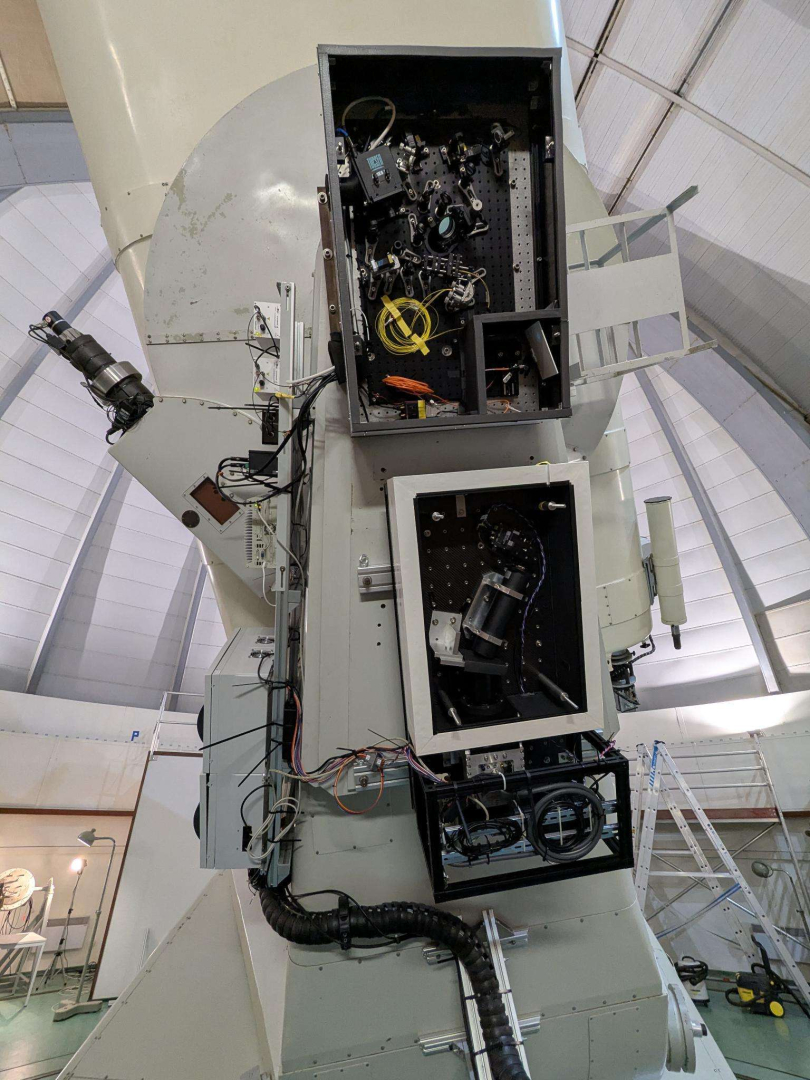 The front end and the new spectrograph are the first components The front end and the new spectrograph are the first components to modernize the optical telescope's spectroscopic instrumentation. Photos: Thüringer Landessternwarte |
Anthology Honors Astronomical Research in the GDR
07.05.2026
A photograph of the Alfred Jensch Telescope in Tautenburg is on the cover of a recently published anthology on astronomy in the German Democratic Republic (GDR). Published by Akademische Verlagsanstalt Leipzig, the collection includes studies, essays, and memoirs.
This is the first time that a historical overview has been dedicated to astronomical research in the GDR. The anthology “Astronomy in the GDR,” edited by Wolfgang R. Dick and Peter Ackermann, presents astronomical research institutions in the Soviet Occupation Zone (SBZ) and the GDR, including Potsdam, Jena, and Dresden. A list of dissertations in astronomy provides an overview of research topics. The essay on the political history of the Astronomische Gesellschaft offers insight into German-German relations.
Furth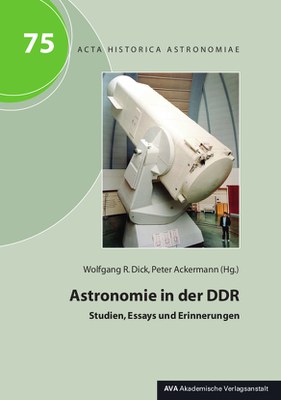 ermore, the book, published in the “Acta Historica Astronomiae” series (Volume 75), describes the lives and work of eight influential astronomers, including Cuno Hoffmeister and Hans Kienle. These eight influential figures exemplify different paths of development in the GDR. Kienle played a key role in the establishment of the Karl Schwarzschild Observatory in Tautenburg with its 2-meter universal telescope.
Dr. Michael Sigwarth, research associate at the Thüringer Landessternwarte, co-authored the biography of Wolfgang Mattig. Mattig was a renowned solar physicist and cosmologist at the Freiburg Institute for Solar Physics (KIS). He had begun his career at the Einstein Tower at the Astrophysical Institute in Potsdam. In 1961, the Einstein Tower was - from a scientific perspective - excellently equipped for the spectroscopic study of the Sun. From there, he moved to the Fraunhofer Institute in Freiburg (todays name is Institute for Solar Physics), which was rather poorly equipped at the time. “Over time, that situation was reversed,” says Sigwarth and adds: “Many of the memoirs and biographies give a sense of the sometimes difficult technical and personal conditions under which outstanding research was conducted in the GDR.”
2-meter telescope at Karl-Schwarzschild observatory was an important research facility
The history of the Karl Schwarzschild Observatory (KSO) in Tautenburg (now the Thüringer Landessternwarte) is not covered separately in this volume. However, KSO is mentioned repeatedly in numerous articles, as the observatory held particular significance for astronomers in the GDR. After all, it was the largest optical telescope in Germany at the time.
“Acta Historica Astronomiae” is a monographic series on the history of astronomy that has been published since 1998 by the Working Group on the History of Astronomy within the Astronomische Gesellschaft (AG).
Bibliographic information: Wolfgang R. Dick, Peter Ackermann (Herausgeber): Astronomie in der DDR (Acta Historica Astronomiae; Band 75), erschienen in der Akademischen Verlagsanstalt, Leipzig, 2025, ISBN 978-3-944913-67-4
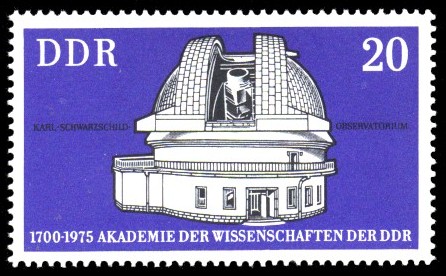 |
| Wie wichtig das Karl-Schwarzschild-Observatorium für die Astronomie in der DDR war, zeigt auch diese DDR-Briefmarke. Am 2. Juli 1975 war ihr Ausgabetag. Die Marke war Teil des Briefmarkensatzes "275 Jahre Akademie der Wissenschaften der DDR". |
Comprehensive Map of the Radio Sky published
19.02.2026
For more than ten years, an international research team involving the universities of Hamburg, Bielefeld, Bochum and Würzburg, as well as the Thuringian State Observatory and the Jülich Computing Centre, observed the northern sky using the LOFAR radio telescope. The researchers have now presented the observational data from this sky survey and published the results in the journal "Astronomy & Astrophysics". The sky survey reveals 13.7 million cosmic radio sources and provides the most complete census yet of active galaxies.
An international team of radio astronomers led by Dr. Timothy Shimwell, scientist at ASTRON, the Netherlands Institute for Radio Astronomy, has used the LOFAR (Low Frequency Array) radio telescope to create an exceptionally detailed map of the sky. The data is now public. The survey (LOFAR Two-metre Sky Survey, LoTSS) maps the northern sky in unprecedented resolution. To create this sky map, the international research team evaluated nearly 13,000 hours of observation time with the LOFAR radio telescope. As a result, 13.7 million radio sources were recorded in a catalog. This is the largest collection of radio sources ever created.
 |
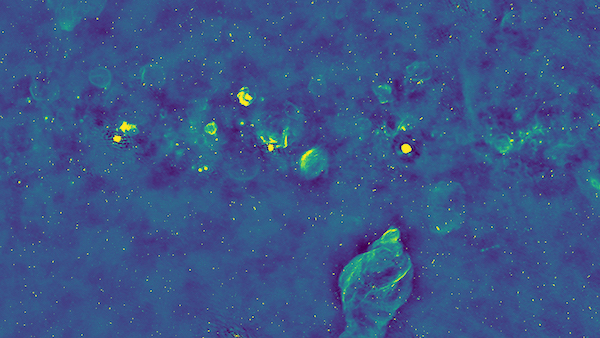 |
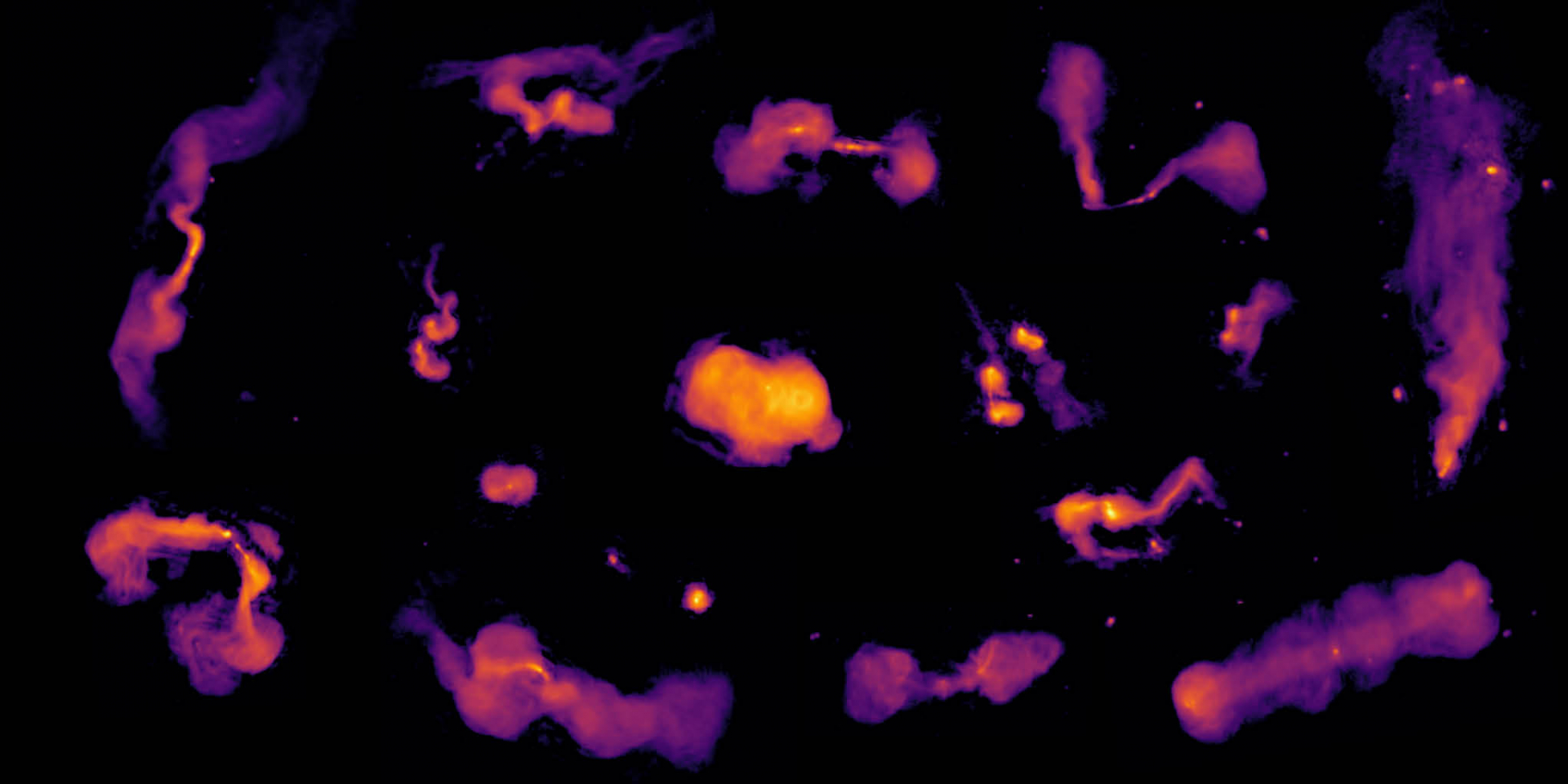
| A selection of active galaxies. The jets visible in the images are powered by supermassive black holes located at the centers of the galaxies. The image illustrates the variety of shapes that can result from the activity of black holes and their interaction with their surroundings. Credit: Maya Horton/LOFAR surveys collaboration | Here, LOFAR looks into our Galaxy toward the constellation Aquila, where many massive stars have exploded. The large Manatee Nebula (lower right) and many other bubble-like supernova remnants are visible in the image. Beyond these is a background of distant radio galaxies seen as faint points. Credit: LOFAR surveys collaboration. |
Radio telescope LOFAR detects rare and elusive objects
Observations made with a radio telescope at low frequencies reveal a completely different picture of the cosmos than observations made with optical telescopes. Radio telescopes can detect processes in the universe that remain hidden from the eye. This allows researchers to track energetic phenomena such as jets from supermassive black holes and galaxies with intense star formation.
In addition to galaxies, the survey has detected other rare and elusive objects, including merging galaxy clusters, faint supernova remnants, and active or interacting stars. The survey is already enabling hundreds of new astronomical studies. It offers fresh insights into the formation and evolution of cosmic structures, how particles are accelerated to extreme energies, and cosmic magnetic fields.
This large-scale radio map of the universe, with unprecedented depth of detail, is now publicly available. "This data release brings together more than a decade of observations, large-scale data processing and scientific analysis by an international research team,” says Dr. Timothy Shimwell, lead author and astronomer at ASTRON and Leiden University, Netherlands.
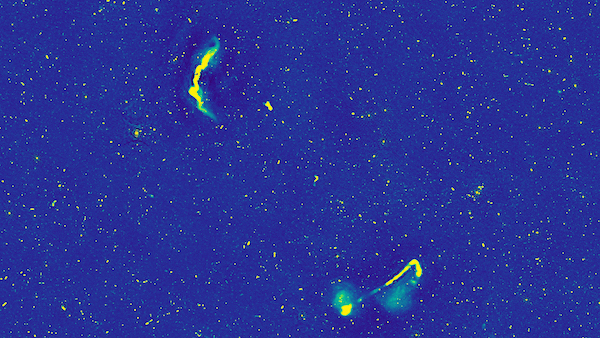 The radio galaxies NGC 315 and NGC 383 dominate this image with spectacular, twisted jets powered by central supermassive black holes. Located about 223 and 209 million light-years away, they stand out against a background of hundreds of far more distant radio galaxies, seen mostly as faint points. Credit: LOFAR surveys collaboration“LOFAR allows us to study cosmic magnetic fields in detail. In doing so, we have discovered that shock waves can accelerate tiny particles very efficiently. These observations are only possible thanks to LOFAR's special capabilities,” says Marcus Brüggen, Professor of Astrophysics at the University of Hamburg. “In addition to insights into the detailed physical processes, the new sky atlas also teaches us how galaxies evolve and how they are arranged in the universe,” adds Dominik Schwarz, Professor of Physics at Bielefeld University.
Enormous challenges for software development and data processing
The research team developed complex software to map the details of the radio sources. One major challenge was to precisely correct for distortions caused by the constantly changing ionosphere (the electrically charged layer of the upper atmosphere). The workflows for processing the 13,000 hours of observations had to be highly automated.
Distributing the computing load across multiple supercomputers and storing and retrieving such huge amounts of data posed further challenges. “The volume of data we handled - 18.6 petabytes in total - was immense and required continuous processing and monitoring over many years, using more than 20 million core hours of computing time,” says Dr. Alexander Drabent, scientist and software developer for LOFAR at the Thuringian State Observatory.
JUWELS, one of Europe's fastest supercomputers, was used for data analysis at Forschungszentrum Jülich. “For this sky survey, such large amounts of data had to be stored, processed, and made accessible for the first time as part of an astronomical observation project. LOFAR has thus paved the way for future large-scale projects,” says Cristina Manzano, Head of Operation & Development Team (ODT) Technical Services at the Jülich Supercomputing Centre (JSC).
Looking forward
LOFAR has been organized as a European Research Infrastructure Consortium (LOFAR ERIC) since 2024. Member states include the Netherlands and the Federal Republic of Germany. Research institutes in Germany operate six of the international LOFAR stations. The network continues to grow: New LOFAR stations are being built in Italy and Bulgaria. In 2025, the Czech Republic joined LOFAR ERIC, and a new station is also being built there.
The LOFAR radio telescope is currently being modernized. The data from the recently published “LOFAR Two-meter Sky Survey” will provide scientists with plenty of material for astronomical discoveries in the coming years. It will now be carefully searched for rare astrophysical phenomena.
Publication
"The LOFAR Two-metre Sky Survey VII. Third Data Release",
T.W. Shimwell et al., Astronomy & Astrophysics
DOI: 10.1051/0004-6361/202557749
Technical Details
Sky Coverage: 19,035 square degrees (including 88% of the northern sky)
Sources Catalogued: 13,667,877
Frequency Range: 120-168 MHz (wavelength ~2 meters)
Angular Resolution: 6 arcseconds (9" below declination 10°)
Median Sensitivity: 92 µJy/beam
Data Volume: 18.6 petabytes processed; 590 TB final products
Observation Time: 12,950 hours over 10.5 years
Processing Power: ~20 million core hours
Data Access
All LoTSS-DR3 data products are publicly available, including images and catalogues covering 19,035 square degrees (46% of the sky), polarization information, calibrated visibility data, and 590 terabytes of final products. These are available through:
https://lofar-surveys.org/dr3.html
https://doi.org/10.25606/SURF.lotss-dr3
About LOFAR-ERIC
The LOw Frequency ARray (LOFAR) is a revolutionary radio telescope developed and built by the Dutch Institute for Radio Astronomy ASTRON. Unlike conventional parabolic antennas, LOFAR consists of thousands of simple antenna elements distributed across Europe and connected via fiber optic networks. The data from all antennas is combined using powerful computers to create images of the radio sky.
LOFAR is operated by the LOFAR European Research Infrastructure Consortium (LOFAR ERIC), an association of institutions from eleven countries (the Netherlands, Bulgaria, Germany, France, Great Britain, Ireland, Italy, Latvia, Poland, Sweden, and the Czech Republic). LOFAR ERIC is an excellent example of successful international scientific cooperation: institutions in different countries pool their expertise, computing power, and research infrastructure across national borders to deepen humanity's knowledge of the origins of our universe.
The international LOFAR telescope is unique due to its sensitivity, large field of view, and image resolution and clarity. The LOFAR data archive is the largest astronomical data collection in the world to date.
Astronomical Research with LOFAR in Germany
The data from the LOFAR sky survey are of great importance for German astronomy. They are used in research networks such as the Cluster of Excellence “Quantum Universe,” the Collaborative Research Center 1491 “Cosmic Interacting Matters - From Source to Signal,” and the DFG Research Group FOR 5195 “Relativistic Jets in Active Galaxies.” The Federal Ministry of Education and Research (BMFTR) is funding the development of LOFAR as part of the joint project 05A2023: “LOFAR: New possibilities and new structure for the leading low-frequency radio telescope.” Six universities (Bielefeld, Bochum, Dortmund, Erlangen-Nuremberg, Hamburg, and Würzburg) as well as the Forschungszentrum Jülich, the Leibniz Institute for Astrophysics Potsdam, the Max Planck Institute for Astrophysics in Garching, the Max Planck Institute for Radio Astronomy in Bonn, and the Thuringian State Observatory in Tautenburg are involved in the operation of the six German LOFAR stations.
Links
LOFAR in Germany
www.glowconsortium.de
LOFAR ERIC
www.lofar.eu
LOFAR on the ASTRON web site
https://science.astron.nl/telescopes/lofar/
Minor Planet Named after former Scientist of our Observatory
21.01.2026
The International Astronomical Union named a minor planet after a former scientist of the Thuringian State Observatory. Dr. David Alexander Kann had spotted the small object with our 2 meter Alfred-Jensch-Telescope while doing routine observations.
The working group "Small Bodies Nomenclature" (SBN) gives names to newly discovered minor planets. The names are published regularly. The first 2026 edition of the WGSBN (Working Group Small Bodies Nomenclature) bulletin, published on January 9, 2026, honors former TLS scientist Dr. David Alexander Kann, among others. The minor planet with the number 635817 is now named after him. Kann is already the fifth scientist from the Thuringian State Observatory to have a minor planet named after him. The others are Richter (number 3338), Börngen (3859), Solf (9872), and Stecklum (69295).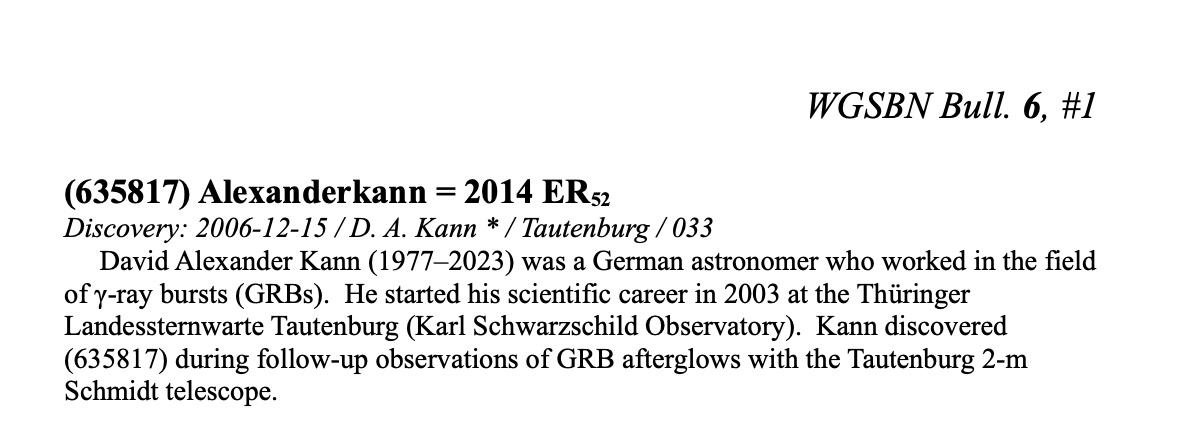
Kann had discovered the minor planet by chance
The discovery of the minor planet dates back 20 years. Kann found the celestial body in December 2006 while conducting follow-up observations of gamma ray bursts with the observatory's 2-meter telescope. Gamma-ray bursts (GRBs) are short-lived bursts of gamma rays. Lasting from a few milliseconds to several minutes, GRBs shine a hundred times brighter than a typical supernova. When a GRB erupts, it is briefly the brightest source of cosmic gamma rays in the observable universe.
Dr. Sylvio Klose, scientist at the Thuringian State Observatory, was Kann's thesis supervisor at the time. Kann carried out the observations on his behalf. “The discovery of the minor planet happened because of Alex Kann's enthusiasm. During a short break in our observation campaign at the time, he pointed our telescope at another interesting spot in the sky – and discovered the minor planet,” recalls Klose.
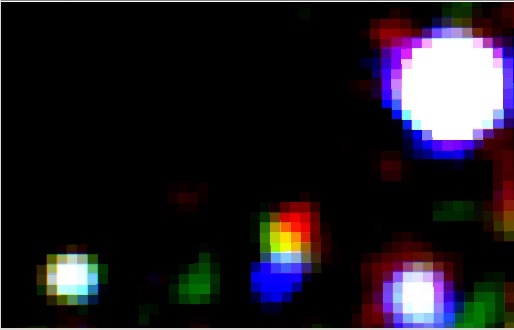 Kann detected the minor planet during routine follow-up observation with the 2 meter telescopeKann first spotted the celestial body on December 15, 2006, while conducting follow-up observations of gamma-ray bursts with the 2-meter telescope at the Thuringian State Observatory. Kann took three images with the 2-meter universal telescope in Schmidt mode, in which he identified the object. In the image on the left, these three images are superimposed in a color representation (red, green, and blue). The stars appear white because they remain in the same position in the images. The minor planet (the multicolored object), on the other hand, moved from southeast to northwest. Due to its low brightness, the contrast of the image is high to make it more visible. This is why noise (blurring) can be seen in the image.
A long tradition of finding minor planets with our 2 meter telescope
The Thuringian State Observatory has a long tradition of discovering minor planets. Freimut Börngen, a former scientist at the Karl Schwarzschild Observatory (as the observatory has been called since it was founded in 1960), specialized in finding these small celestial bodies orbiting the sun in the 1970s. He could name the minor planets he discovered. That is why, for example, a minor planet called Tautenburg orbits the sun today.
Dr. Bringfried Stecklum, scientist at the Thuringian State Observatory, has continued and significantly modernized the observations of asteroids that Börngen began around 50 years ago. Under his leadership, the Thuringian State Observatory has been involved in the classification and monitoring of near-Earth objects since 2010. Since 2019, this has been done in collaboration with the European Space Agency (ESA). With an average of 6,000 measured orbital positions per year, our research institute is now one of the most productive observatories in Europe in this field.
David Alexander Kann passed away in 2023 at a young age. Bringfried Stecklum initiated that the minor planet discovered by Kann be named after him. The minor planet with the number 635817 will now always commemorate David Alexander Kann.
Northern Lights visible at the Observatory
20.01.2026
During the night of January 20th, 2026, as well as in the following night, there were multiple observable auroras all over Germany. The sky was filled with vivid red and green hues.
 2-Meter-Alfred-Jensch telescope with aurora borealis in the night sky. Photo: Jochen Eislöffel, Thüringer LandessternwarteThis colourful event is linked to strong solar activity that happened on January 18th: an eruption in the active region AR14341. The event was classified as X1.9 on the flare classification scale, which means that it can have a major global impact.
These solar eruptions are caused by twists in the concentrated magnetic field on the Sun that manifest as sunspots. The continuous convective motions on the Sun cause the twisting in the magnetic fields storing enormous amounts of energy. When the magnetic field suddenly gets rearranged due to solar dynamics, this energy is released, oftentimes leading to an ejection of mass. The energy heats up the surroundings, causes intense electromagnetic radiation, and accelerates the charged particles such as protons and electrons.
The charged particles take several hours to arrive here on Earth. As the electromagnetic radiation reaches the Earth in about 8 minutes after the eruption, the eruptions can be “seen” immediately. They are deflected by the Earth’s magnetic field, and redirected to the polar regions. When the eruption is strong enough, the particles can reach places farther away from the polar regions as was the case on January 20th. That’s why we saw polar lights in Germany – a rare phenomenon.
The particles interact with Earth’s upper atmosphere producing different colours of light, commonly green and red (Oxygen), and rarely violet (Nitrogen).
Author: Pauline Kassebeer, student at Sebastian-Münster-Gymnasium in Ingelheim, and intern at the Thuringian State Observatory
Fortunately, the night sky is still pretty dark at the Thuringian State Observatory. That's why we had a great view of the aurora borealis. Here are some impressions of the polar lights above Tautenburg (Copyright for all photos: Thüringer Landessternwarte):
|
|
|
|
 |
 |


A very fast and bright meteoroid over Tautenburg
12.12.2025
It is not an event that you see every day (or in this case: every night): The meteor camera at the Thuringian State Observatory recorded a very bright fireball during the night of November 18, 2025. The European Fireball Network, run by scientists at the Astronomical Institute of the Czech Academy of Sciences, analyzed recordings of this meteoroid. Here is what they found out about this spectacular celestial event that lasted only a few seconds.
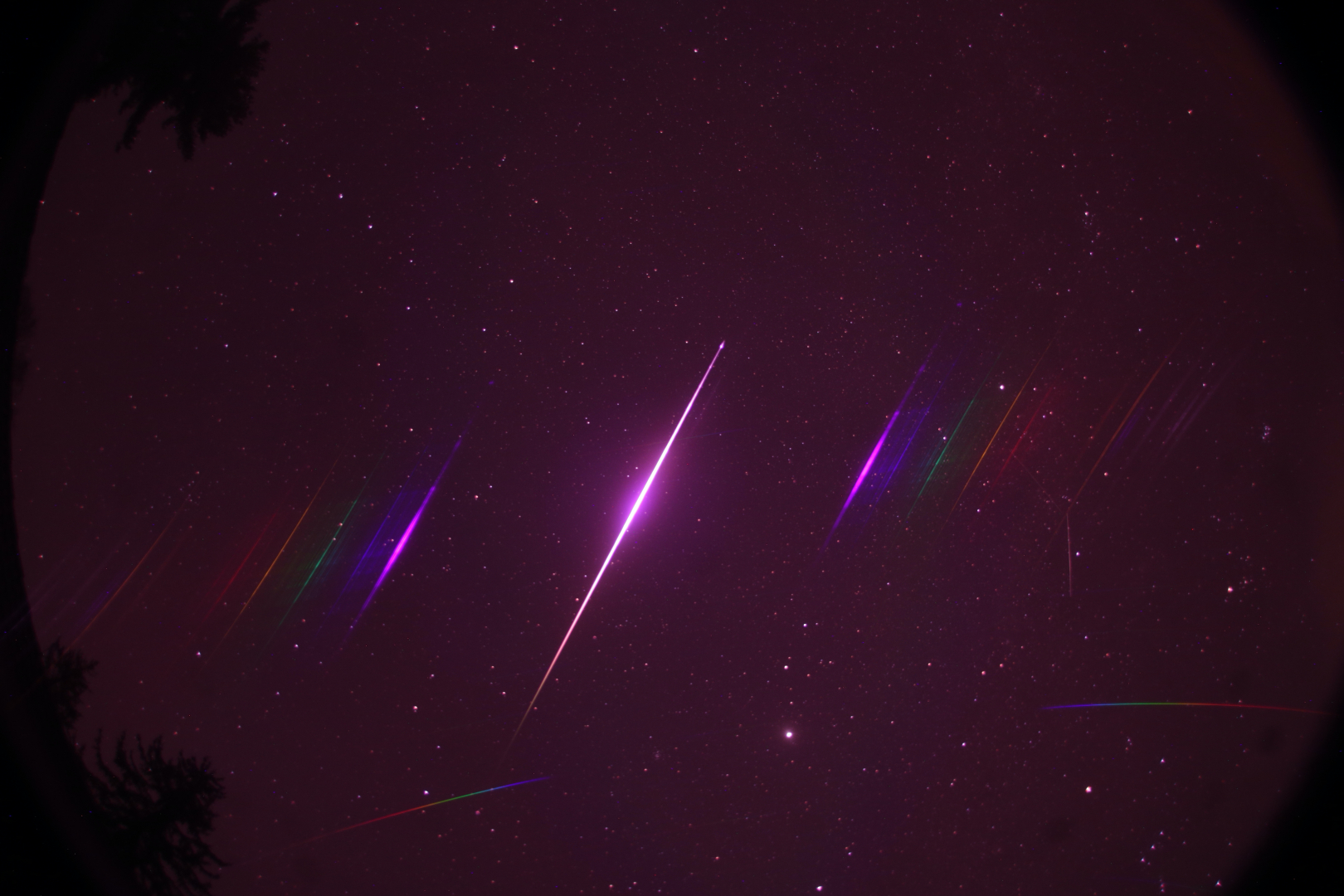 A fireball recorded by the meteor camerat at Tautenburg. Photo: Astronomical Institute of the Czech Academy of Sciences
The fireball was visible for only two seconds, but that was long enough to leave a bright streak on the meteor camera at the Thuringian State Observatory. Asteroids and meteoroids enter the Earth's atmosphere all the time. When they burn up, they turn into shooting stars (meteors). If part of them makes it all the way to Earth, the piece of rock is called a meteorite. Sometimes meteors appear even brighter than the planet Venus – then they are called “fireballs”.
In order to study meteoroids more closely, the European Fireball Network, based at the Astronomical Institute of the Czech Academy of Sciences in Ondřejov, has distributed special meteor cameras across a large area of Central Europe. One of them is located at the Thuringian State Observatory.
The bolide (a technical term for the fireball) that briefly lit up the sky above Tautenburg on November 18, 2025, was observed by special cameras belonging to the European Fireball Network. Since almost all of the meteor cameras closest to the fireball's trajectory had clear skies (translating into a clear view), the recordings enabled a thorough analysis. The Czech astronomers were able to use the images to study its trajectory and other parameters.
The fireball flew practically directly over the Thuringian State Observatory. Using a wide-angle spectral camera, it was possible to capture an exceptionally bright and detailed spectrum of the fireball. Pavel Spurný, a researcher at the Astronomical Institute of the Czech Academy of Sciences, recently published this data:
Meteor camera recordings enable analysis
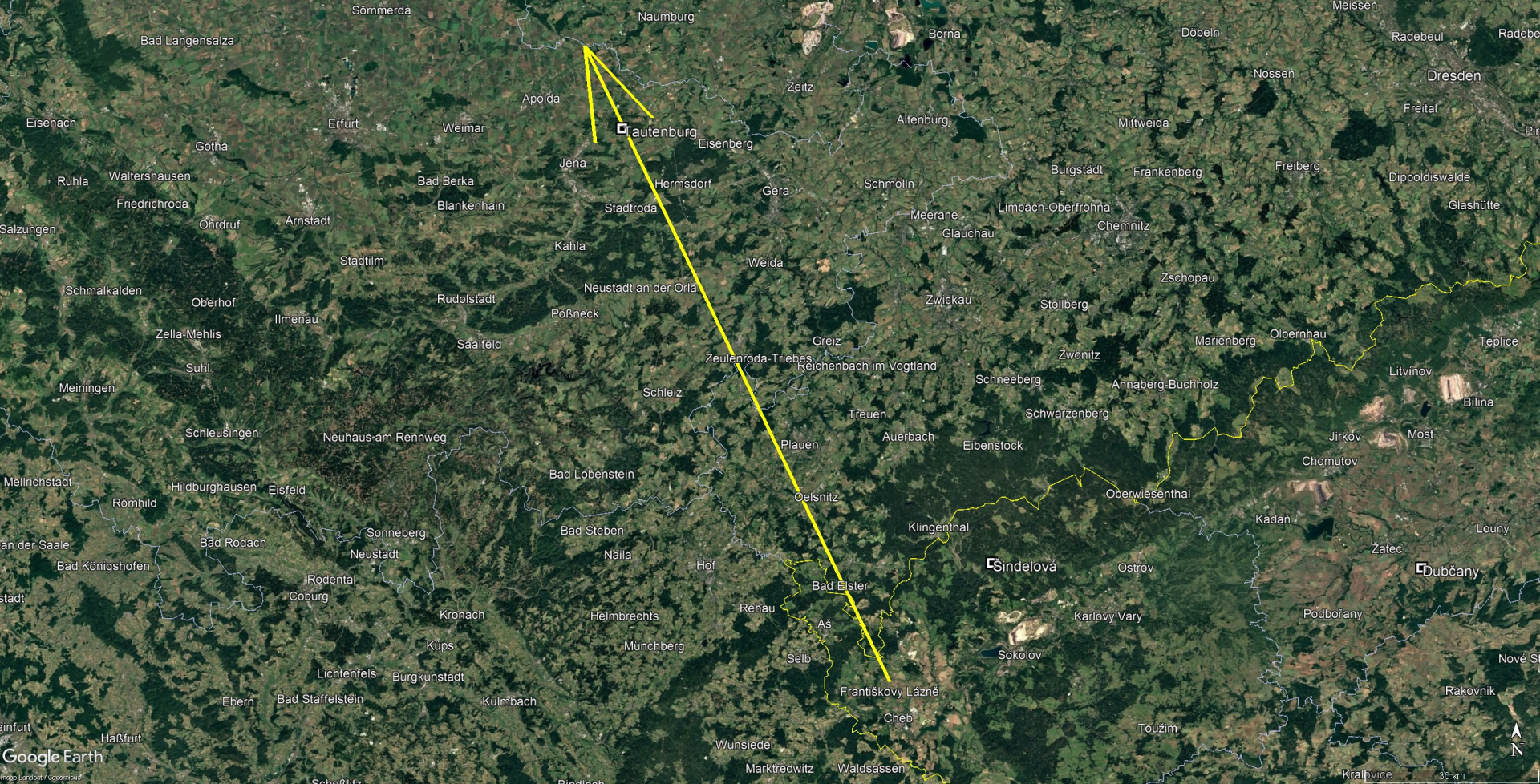 Projection of the light path of fireball EN181125_040337 in the atmosphere onto the Earth's surface (yellow arrow). The actual light path was 141 km long and the object flew it in 2 seconds. (Graphic: Astronomical Institute of the Academy of Sciences of the Czech Republic, background map: Google Earth)At 4:03:37 UTC, a small meteoroid (designated EN181125_040337) weighing only 45 grams entered the Earth's atmosphere and began to glow brightly. The object was moving at a very high speed of 70 km/s in a northwesterly direction and quickly became brighter. At its maximum brightness, the bolide reached a luminosity comparable to that of the full moon. The light trail of the bolide in the atmosphere recorded by the cameras was 141 kilometers long. After only two seconds, the bolide burned up at an altitude of 69 kilometers northwest of the observatory in Tautenburg.
Meteoroid burns up in Earth’s atmosphere
It was a body of cometary origin, which means that it is normally made of very fragile material. However, this celestial body had a slightly more solid structure than is usually the case with such cometary fireballs. Due to its small size and high speed, the original meteoroid completely disintegrated in the atmosphere and its entire original mass vaporized.
Before colliding with Earth, this meteoroid orbited the Sun on a very elongated elliptical orbit. This is typical for long-period comets. When close to the Sun, it passed between the orbits of Earth and Venus, and when far from the Sun, it passed far beyond the orbit of the last planet in our solar system, Neptune. Its orbit around the Sun took 250 years.
The Thuringian State Observatory and the Astronomical Institute of the Czech Academy of Sciences have a longstanding cooperation. They are both part of the PLATOSpec consortium.
New conference at Thuringian State Observatory puts spotlight on young scientists
02.12.2025
For the first time, young researchers at the Thuringian State Observatory held a one-day conference in Tautenburg. This new format gave Bachelor, Master and Ph.D. students a platform for presenting their work to the whole institute.
Academic research profits from exchanging ideas. Scientific ideas and results are presented in (written) papers and in talks. Therefore, giving talks is part of a researcher's work. However, it can be intimidating for early-career scientists to speak in front of a big audience. So why not create an opportunity for Bachelor, Master, and Ph.D. students to speak about their work and practice giving scientific talks?
That is the idea behind the Early Career Scientists’ (ECS) Conference held on November 6, 2025, at the Thuringian State Observatory. 14 young scientists seized the opportunity to cover a wide range of topics: extragalactic astronomy, stellar astrophysics, solar physics, galaxies, data analysis, remote sensing, and hardware programming.
A familiar setting for practicing
 Early-career scientists at the Thuringian State Observatory. Photo: Thuringian State ObservatoryHemanth Pruthvi, one of the organizers of the Early Career Scientists’ Conference, explains the motivation for coordinating the event: “Most of the ECS members are at the beginning of their academic journey with little exposure to science communication. At some point, they will need to communicate their work to their peers, veterans and laypeople in a public setting. This conference is an attempt to ease them into the process by having them present their work in a familiar, albeit scientifically rigorous setting.”
The young scientists could choose the content of their presentation: an ongoing project, past work, a future plan of action or even a literature survey. Every speaking slot was 15 minutes long, typical of any scientific conference: 10 minutes to present and 5 minutes for discussion. Participation was open to all staff members at the observatory. The audience could listen to the presentations and discussions in person or via zoom.
Apart from ECS members, the director, several of the institute faculty, and technical personnel attended the conference. Jana Köhler, also an organizer of the ECS conference, concludes: “The enthusiastic participation and the intriguing discussions showed that this conference was a success. There is also eager anticipation for the next conference, especially from the new members who couldn’t present this time.”
Big interest in the next ECS conference
The organizing team, comprised of Hemanth Pruthvi, Jana Köhler and Aashana Tripathi, plans to repeat the format. “Another ECS conference will be held when we have a substantial number of new members and/or new work to be presented”, says Aashana Tripathi.
Markus Roth, director of the Thuringian State Observatory, supports the initiative started by the young scientists: “I am very grateful that Hemanth Pruthvi, Jana Köhler and Aashana Tripathi organized this conference. This is a very innovative way to support our early-career scientists. I also thank all the speakers who gave presentations. The institute really profits from this format because it makes everyone here aware of how much is going on at the observatory. The conference is a good example of how to exchange ideas beyond everyone's own research group.”
Thuringian State Observatory supports research to protect Earth from Asteroids
20.10.2025
A research team led by Auriane Egal from Western University in Ontario, Canada, describes the details that could be determined about the explosion of asteroid 2023 CX1 in February 2023 in the journal Nature Astronomy. The Thuringian State Observatory is involved in this important publication.
On February 12, 2023, Krisztián Sárneczky discovered an asteroid at the Konkoly Observatory in Hungary. The asteroid, named "2023 CX1", had a diameter of just under one meter and an estimated mass of about 650 kilograms. Seven hours after it was first sighted, it exploded over Normandy in France. Now, an international team of researchers has published a comprehensive study on it.
 Landscape photographer Gijs de Reijke captured this spectacular image of fireball 2023 CX1 over northern France as the meteor broke up and vaporized. Photo: Gijs de Reijke2023 CX1 is one of the very rare cases of a cosmic object being discovered before it entered Earth's atmosphere. This made it possible to track its path from space until it impacted Earth. Using new and innovative observation strategies, the European Space Agency (ESA) and the US space agency NASA were able to predict the time and the location of the fall of 2023 CX1 with unprecedented accuracy. Dutch landscape photographer Gijs de Reijke managed to capture a spectacular image of the meteor shortly before it broke apart over Normandy.
As many aspects as possible examined
More than 100 scientists, including meteorite physicists and amateur observers from Europe, America, Africa, and Australia, have joined forces to investigate all aspects of this extraordinary event: discovery with telescopes, tracking of the orbit, atmospheric observations using optical, infrasound, and seismic data, and geochemical laboratory analyses. Their findings are summarized in the article "Catastrophic disruption of asteroid 2023 CX1 and implications for planetary defense", published in September 2025 in Nature Astronomy. The Thuringian State Observatory is part of the author team.
 Trajectory of Asteroid 2023 CX1. Source: ESA NEO2023 CX 1 shattered around 28 kilometers above the Earth – and not just upon impact with the Earth's surface. It released 98 percent of its energy in a fraction of a second. The explosion scattered more than a hundred fragments over Normandy. Since the location and time were known, researchers set out to search for remnants of the asteroid. And indeed, they found what they were looking for. Small fragments of the meteorite were then examined in the laboratory.
Explosion with great force
The asteroid exploded so quickly and with such force that its behavior highlights the potential danger of similar – and larger – astronomical objects. That is why the analysis of asteroid 2023 CX1 represents a unique opportunity for science, but also for protecting Earth from asteroids. Auriane Egal, professor at Western University in Ontario, Canada, and lead author of the article, says: "We have confirmed the existence of a new population of asteroids associated with L-type chondrites that are capable of breaking up abruptly in the atmosphere and releasing almost all of their energy at once. Such asteroids must be taken into account in strategies to protect Earth, as they pose an increased risk to populated areas."
Thuringian State Observatory operates a meteor camera
Since 2010, the Thuringian State Observatory has been participating in the classification and monitoring of near-Earth objects with its 2-meter Alfred Jensch telescope. It operates a meteor camera as part of a larger network of such observation instruments for asteroids and minor planets.
Continuous measurements of the celestial position of newly discovered and known near-Earth asteroids increase the accuracy of their orbits. This makes it easier to assess whether a new object is close to Earth or not, or whether the danger posed by a known asteroid has decreased or increased. With an average of 6,000 measurements per year, the TLS is now one of the most productive observatories in Europe in this field.
Links
News Release, Western University
ESA Near-Earth Objects Coordination Center
Asteroid 2024 BX1 observed at the TLS shortly before its impact near Berlin
Background Information: What is an airburst?
What happens to an asteroid when it enters the Earth's atmosphere at high speed depends on how big it is. The celestial body heats up so much due to friction that it vaporizes on the surface. Bodies smaller than a few centimeters vaporize completely. Bodies larger than 10 meters remain intact and strike the Earth.
In the size range in between, the following occurs: The surface of the celestial body reaches temperatures of 2000 to 3000 degrees Celsius, while the center remains at around -70 degrees Celsius. This creates thermal stresses that cause the asteroid to burst apart – just as glass shatters when it is suddenly heated to a high temperature. The resulting fragments give the atmosphere a larger surface area to attack, which intensifies the process. The technical term for this phenomenon is "airburst."
Science Minister Christian Tischner visits the Thuringian State Observatory
08.09.2025
Thuringia's Minister of Education, Science, and Culture, Christian Tischner, visited the Thuringian State Observatory. Professor Markus Roth, Director of the Thuringian State Observatory, presented an overview of the research conducted at the institute.
As a research institution not affiliated with a university, the observatory is under the authority of the Thuringian Ministry of Science. Minister Tischner used the visit to get to know the astronomical research institute better. Director Markus Roth welcomed him in the dome of the 2-meter Alfred Jensch telescope and introduced him to the various telescopes and instruments: in addition to the optical 2-meter telescope, these include the Low Frequency Array (LOFAR) radio telescope and the Tautenburg Solar Laboratory.
 Thuringia's science minister Christian Tischner and TLS director Markus Roth in the dome of the 2-Meter Alfred Jensch telescope. Photo: TLSResearchers at the Thuringian State Observatory (TLS) are involved in numerous national and international projects. Roth gave an overview of the latest projects, such as PLATOSpec and SPRING. SPRING, which stands for Solar Physics Research Integrated Network Group, is a modern, global network of solar telescopes that will be used to continuously observe the sun in the future. PLATOSpec is a high-resolution spectrograph that supplements the sky observations of the European Space Agency's PLATO satellite mission with ground-based observations.
Extremely positive development of the research institute
Minister Tischner emphasized that, while preparing for the visit, he had seen how well positioned the research institute is and how well it has developed in recent years. He referred to the results of the evaluation of all state-funded non-university research institutes in the Free State of Thuringia by the Scientific Commission of Lower Saxony at the end of 2023. This evaluation, commissioned by the then Thuringian Ministry of Economics, Science, and Digital Society (TMWWDG), attests to the extremely positive development of the Thuringian State Observatory: “In the opinion of the expert commission, the Thuringian State Observatory is an efficient and internationally recognized research institution of systemic relevance for the entire astronomical community in Germany and beyond.” In his welcoming speech, Tischner commented: “What you have set in motion is worth continuing.”
 |
|
|
Minister Christian Tischner and Direktor Markus Roth observe how the 2-Meter telescope moves. Photos: Thüringer Landessternwarte |
(left to right) Andrea Schmidt, business manager at TLS, Matthias Hoeft, deputy director at TLS, Thurinigan science minister Christian Tischner, Markus Roth, director of TLS, Vera Hejduk, Thuringian Ministery for Education, Science, and Culture |

TLS and Fraunhofer IOF develop single-mode fiber coupling for telescopes with adaptive optics
04.08.2025
The Thuringian State Observatory in Tautenburg and the Fraunhofer Institute for Applied Optics and Precision Engineering IOF in Jena are jointly developing a key technology that can be used for astronomical measurements of stars and in modern devices for transmitting encrypted data. The FREEFIB research group is focusing on the development of compact adaptive optics for the efficient feeding of light into a single-mode fiber optic cable.
Anyone who has looked up at the starry sky on a clear night is familiar with the phenomenon: the stars twinkle. This twinkling is not caused by the stars themselves, but by air turbulence in the Earth's atmosphere. Layers of air with different temperatures are mixed together, creating turbulence.
This effect, known in astronomy as “seeing,” reduces the resolving power of telescopes — even at the best locations for astronomical observations. As a result, stars, which are actually perfect point sources of light, are imaged by telescopes as blurred spots.
This, in turn, means that instruments for spectroscopic analysis of starlight must be built correspondingly larger (and thus also more expensive) – or a large portion of the light captured by the telescope is lost. If it were possible to avoid the negative effect of “seeing,” spectrographs for detailed studies of stars could be built much more compactly.
Correcting light distortion with adaptive optics
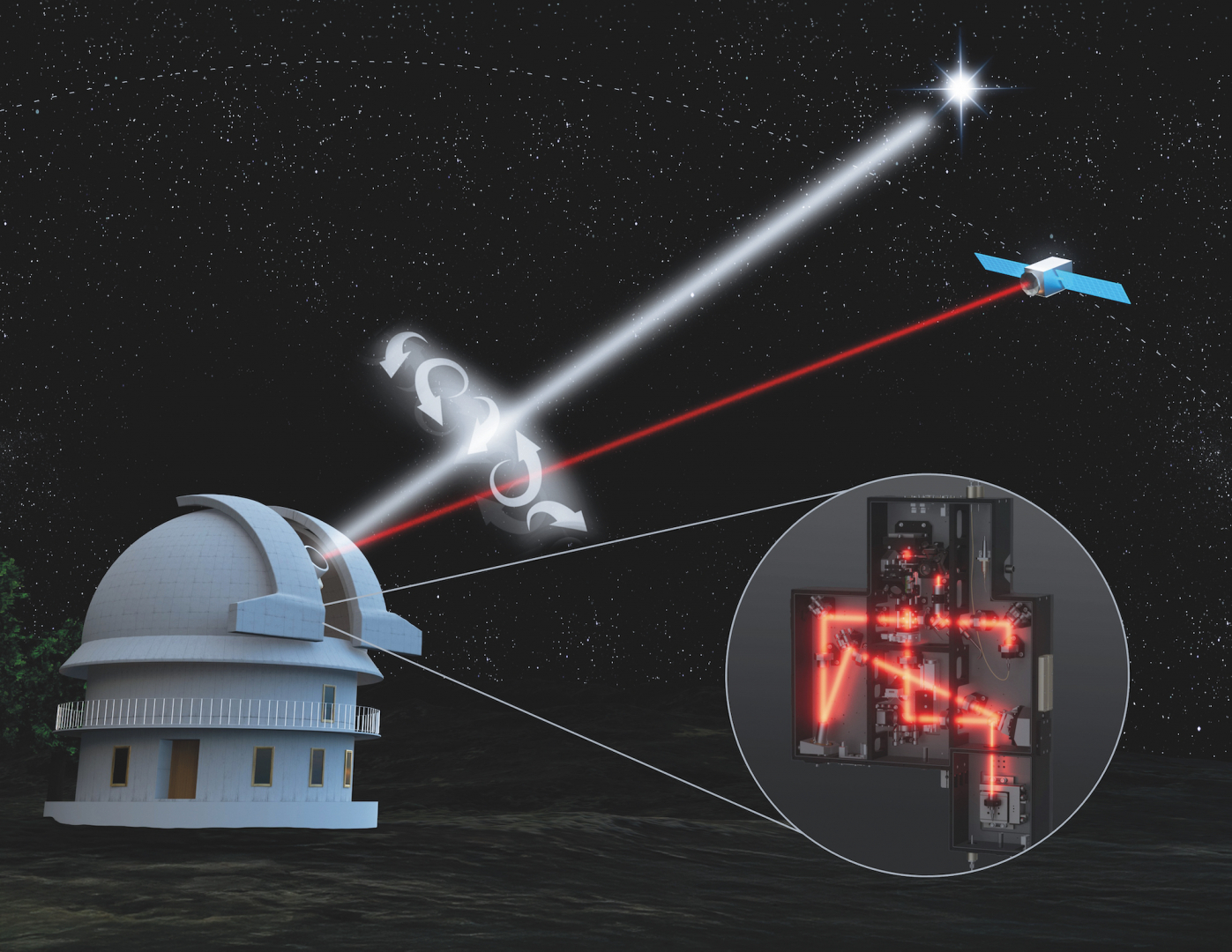 Atmospheric turbulence causes wavefront distortions, which are problematic for astronomical observations, for example. A compact module with adaptive optics (enlarged on the right) is designed to help correct the effects of atmospheric turbulence. Illustration: Fraunhofer IOFCorrecting seeing is technically possible. It can be achieved using what is known as adaptive optics. This is a technology that can largely correct the distortions in starlight caused by atmospheric turbulence. Adaptive optics has been used successfully for around 20 years on large telescopes in the eight-meter class. However, it is not yet widely used on smaller telescopes due to its cost and complexity.
The Thuringia State Observatory and Fraunhofer IOF want to change that. Their FREEFIB research group works on a solution for coupling a laser beam, which is transmitted through the air via a free beam on an optical line-of-sight connection, back into an optical fiber, specifically a single-mode fiber. The goal is to develop a compact and cost-efficient module for fiber coupling of starlight or laser light for telescopes in the one- to two-meter class. The name FREEFIB is a combination of the free beam of light, or “free space,” which is directed into a fiber.
Reducing signal loss between ground stations and satellites
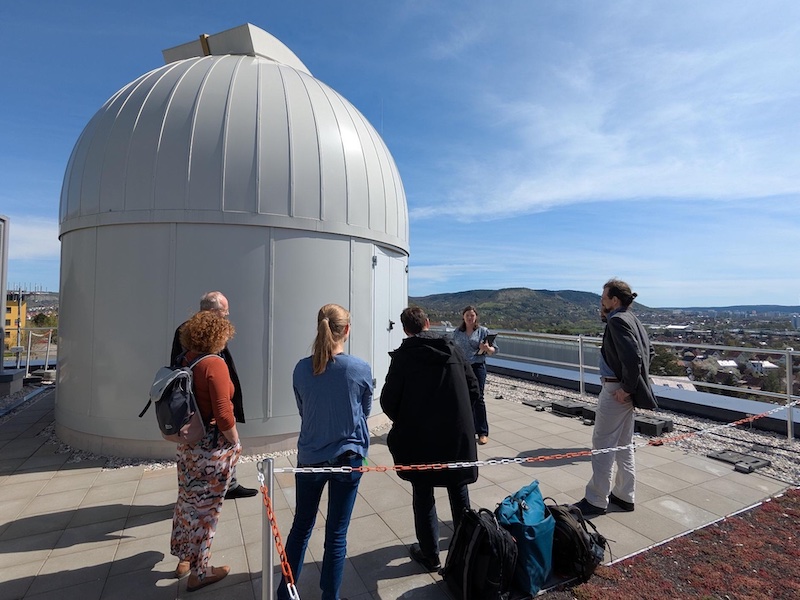 Members of the FREEFIB research group on the roof of the Fraunhofer IOF in Jena. Aoife Brady (fifth from left) explains the function of the optical ground station. The dome houses a fast-moving telescope for optical communication with satellites. Photo: TLSFraunhofer IOF is a pioneer in applied research on laser communication and quantum encryption. Similar to telescopes in astronomical research, atmospheric turbulence causes high signal losses between optical ground stations and satellites in laser-based signal transmission. The solution here, too, is adaptive optics.
The Thuringian State Observatory is planning to build an ultra-high-resolution spectrograph for long-term asteroseismic studies of bright stars. In both applications, it is necessary for the light received by the telescope to be fed into a thin glass fiber (single-mode glass fiber) so that it can be transmitted to an analysis device. This is referred to as fiber coupling.
Professor Dr. Markus Roth, director of the Thuringian State Observatory, is delighted about the collaboration with the Fraunhofer Institute for Applied Optics and Precision Engineering IOF: "The FREEFIB research group brings together two partners who want to tackle a similar technical challenge. It is a huge advantage that there is such a large network of optics specialists in Jena. This facilitates cooperation. Both research institutes will benefit from the results."
"TLS Tautenburg and Fraunhofer IOF Jena are continuing their successful cooperation in the FREEFIB research group. The expertise of both institutes makes it possible to adapt single-mode fiber coupling technology for larger telescopes. The challenge is to simplify adaptive optics and thus also address new applications beyond communication and spectroscopy,“ says Dr. Ramona Eberhardt, deputy director at Fraunhofer IOF.
FREEFIB continues until December 2027. The research is financed by the Free State of Thuringia with funding from the European Social Fund (ESF) Plus.
Obituary: Dr. Patrick Gaulme
31.07.2025
Patrick Gaulme, tenured researcher at the Thüringer Landessternwarte - Karl Schwarzschild Observatory, passed away on July 14, 2025, at the age of 47, following pancreatic cancer.
Patrick was born in Paris on July 22, 1978. He got his PhD in Astrophysics at Université Pierre et Marie Curie in 2005 under the supervision of Prof. Benoît Mosser. The subject of the thesis was "Jovian seismology: the study of oscillations by visible photometry and data analysis of spectral data".
|
|

At the end of 2005, he moved to Nice for a postdoctoral position under the supervision of Dr. François-Xavier Schmider as the co-leader of the SYMPA project, a ground-based Doppler spectro-imager dedicated to seismic studies of Jupiter. Two years later, he moved back to Paris as a teaching assistant, where he conducted research on Venus’ atmospheric dynamics in support of ESA’s Venus Express mission.
In 2008, he was offered a three-year contract as an instrument scientist at the Institut d’Astrophysique Spatiale under the supervision of Dr. Thierry Appourchaux for implementing a Doppler spectro-imager aboard the ESA-NASA Juice mission. He also took part in the data analysis of the Kepler (NASA) and CoRoT (CNES) data, broadening his palette to include studies of other stars and planets.
In 2011, he moved to Las Cruces, New Mexico, USA, where he joined New Mexico State University as a postdoctoral researcher. He worked with Prof. Jason Jackiewicz on red giant stars in binary systems and on a ground-based version of the Doppler spectro-imager. His generous mentoring of graduate students led to several interesting PhD dissertations. He then became a support astronomer at Apache Point Observatory, performing service observations for the community with the Sloan Digital Sky Survey.
At the end of 2017, Patrick joined the team of Prof. Laurent Gizon at the Max Planck Institute for Solar System Research in Göttingen, Germany. There, he played a key role in the scientific preparations for ESA’s exoplanet and stellar-physics mission PLATO, scheduled for launch in December 2026. He initiated the Data Analysis Support Tools effort, providing the interface between the mission database and hundreds of consortium scientists. In parallel, he led a small team of postdocs and students at the institute, focusing on asteroseismology, particularly of binary stars.
In June 2023, he got a tenure-track scientist position at the Thüringer Landessternwarte (TLS) in Tautenburg, where he carried out observations at the Karl Schwarzschild Observatory. He started giving lectures at the Friedrich-Schiller-University in Jena and supervising students together with Prof. Dr. Markus Roth.
While on a conference trip to Padova, in July 2024, he first noticed symptoms that were later diagnosed as pancreatic cancer. Despite facing a terminal illness, he remained optimistic and determined to fight it. He stayed active in research and visited the institute whenever possible to attend open-door days and colloquia and meet with colleagues.
The many different positions held by Patrick reflect his openness and across-the-board skills. He was equally passionate about developing new instrumentation and exploring the scientific discoveries they would enable. He had a broad mind, working across diverse fields of physics, an uncommon trait among today’s scientists. This broad scientific knowledge and curiosity were Patrick’s defining qualities. Crossing disciplinary borders, he organized an exchange with the Bauhaus University Weimar where art and design PhD students and professors met astrophysics students and scientists from TLS. Anybody who attended these meetings, will now view Jupiter in a different light.
But a life cannot be summarized in the many positions one had. Patrick was more than a mere scientist. His broadness of mind was patent in his musical culture: rock’n roll at heart but obviously psychedelic. He definitely liked to play music and his guitar; at the end of June, he put some songs on the soundcloud.com platform. Patrick’s artistic talents extended beyond music, as shown in this magnificent portrait of the Karl Schwarzschild Observatory under a sky full of aurorae and stars.
|
Aurora over the Karl Schwarzschild Observatory. New Year’s card drawn by Patrick sent to TLS staff, and used as seasonal greetings of TLS in winter 2024/2025. Painting by Patrick Gaulme in India ink on “cappuccino” paper from Hahnemühle. |

Patrick was also a true Parisian, exploring the intricate tunnels of the catacombs, or sneaking on a scaffolding for exploring Notre Dame by night. He also had a great interest in photography, not the digital kind but the old-fashioned argentic one. He also paid a keen interest to the old oak tree in Meudon by making a time lapse of its evolution during his PhD thesis, showing his patience, contemplation, precision and rigor. He was also a true dreamer, fulfilling both his and Paola’s wish to own a fancy VW combi, and together they re-discovered the world around Las Cruces in this old fashioned “car”. Their dreams expanded along with their growing family.
Patrick is survived by his beloved wife Paola and their four children. Patrick was a beautiful mind, he will be deeply missed by his family, friends and collaborators. Patrick has returned to the stars, at peace and serene. We will not forget him.
Thierry Appourchaux, Laurent Gizon, Jason Jackiewicz, Benoît Mosser, Markus Roth, François-Xavier Schmider
Interdisciplinary conference on the Physics of the Sun
14.07.2025
Scientists took an interdisciplinary look at our Sun during a Spanish-German research seminar. Markus Roth, director of the Thuringian State Observatory was one of the scientific co-organizer of the conference.
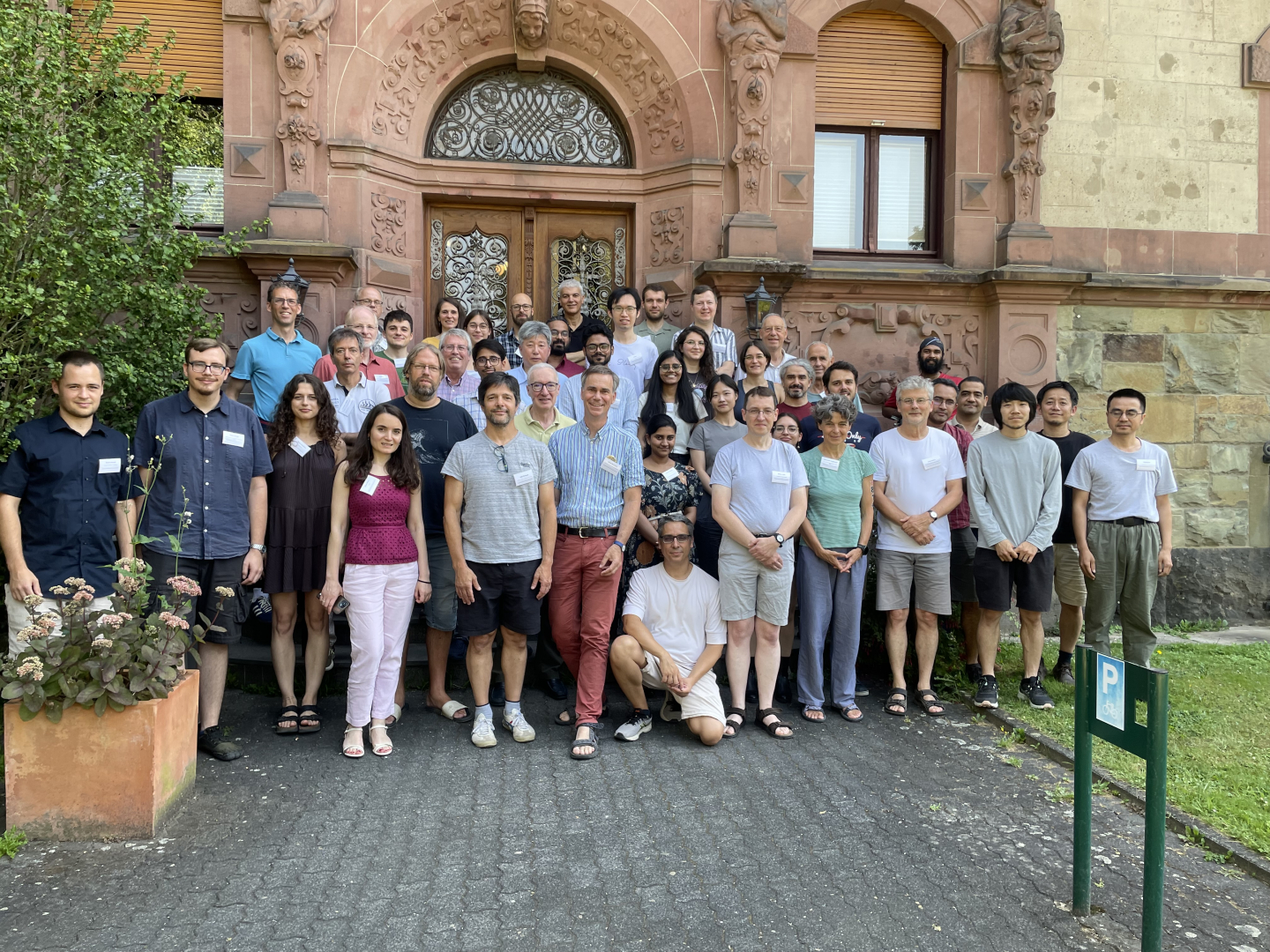
"Interdisciplinary Physics of the Sun" – that was the focus of a conference taking place at the Physikzentrum Bad Honnef, Germany, from June 29 to July 4, 2025. It was jointly organized by Markus Roth, Daniel Bemmerer of the Helmholtz-Zentrum Dresden-Rossendorf, and Aldo Serenelli of the Institute of Space Sciences in Cerdanyola del Valles, Spain. The Wilhelm und Else Heraeus-Stiftung financed the conference.
 Since several decades, close scientific ties exist between Spanish and German astronomers. At the Observatorio del Teide on the Canary Island of Tenerife, for example, solar physicists from both countries use the Vacuum Tower Telescope and GREGOR, both solar telescopes, to study processes on our star.
Modeling magnetic eruptions in the corona
At the conference, the Spanish-German research team that uses the solar telescopes on the Canary Islands reported on new observations and modeling of magnetic eruptions in the corona, which can now be studied with a resolution in the 100 km range and provide insights into space weather.
Although the planned European Solar Telescope (EST) and the new telescope network “Solar Physics Research Integrated Network Group” (SPRING) are not yet in place, new instrumental and analytical work, particularly from German institutes, are already helping to understand the physics behind solar activity. Research that traced the total radiation of our sun back over thousands of years using historical records and isotope data is very closely related to current problems.
Improved data on neutrino fluxes expected
The cross sections for the fusion reactions of the proton-proton chains and the CNO cycle (named after the elements carbon, nitrogen, and oxygen, which act as “catalysts”) that were reevaluated as part of the “Solar Fusion III Review” were compared with the latest solar model. Although there is currently no dedicated solar neutrino detector, there is justified hope that the neutrino experiments SNO+ (successor to the Sudbury Neutrino Observatory), JUNO (Jiangmen Underground Neutrino Observatory) and probably also the liquid xenon detectors will provide improved data on solar neutrino fluxes in the coming years as a kind of by-product. In the US, two laboratories are working to remeasure the opacities of elements relevant to the Sun.
A total of 56 participants from Germany and partner country Spain, as well as Algeria, Belgium, China, Great Britain, Italy, Japan, the Netherlands, South Korea, and the US, discussed recent advances and new research questions relating to the Sun. Topics ranged from particle physics and magnetohydrodynamics to the effects on the Earth's climate. During the conference, research results and posters by young researchers received awards.
One of the insights gained from the workshop was that the interdisciplinary exchange was particularly fruitful because it brought together two traditionally separate research disciplines, namely nuclear physics and astrophysics. This is evident, for example, in questions about element abundances, for which new evaluations of Fraunhofer absorption lines were presented. These are closely linked to the modeling of material transport and its development in the Sun and, via nuclear reactions, also to neutrinos from the sun's interior. There is great hope that the contacts made during the conference will spark new directions in research in the future.
|
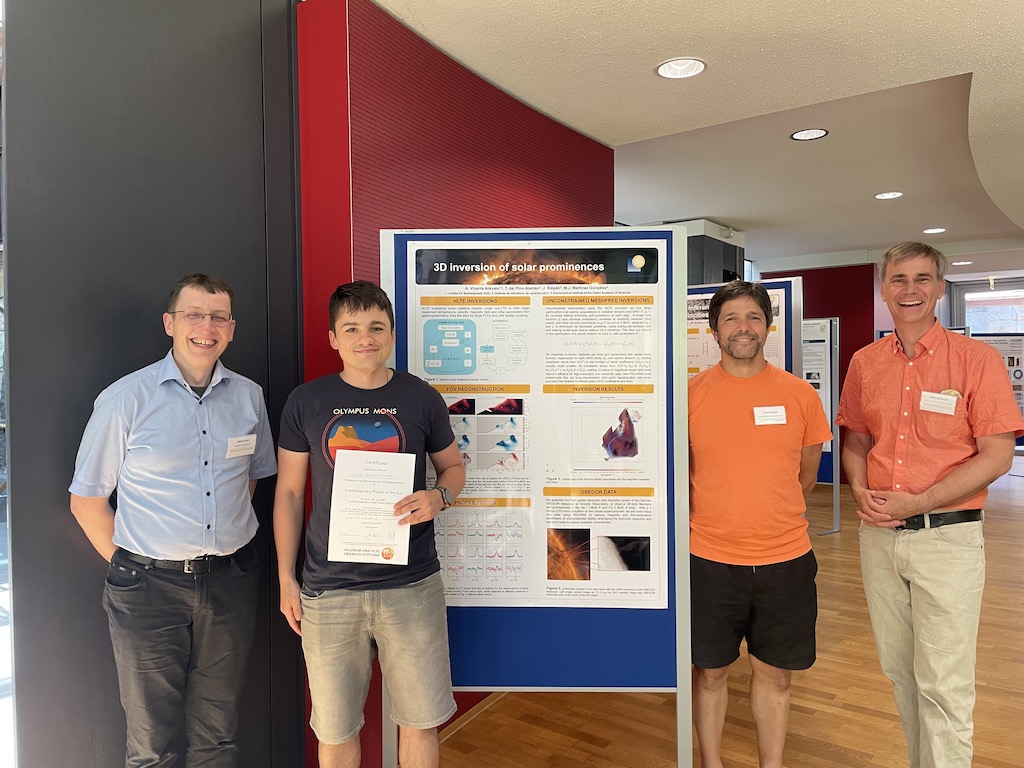
Andres Vicente Arevalo (second from left) from the Institut für Sonnenphysik (KIS) was awarded a price for his poster "3D inversion of solar prominences". Next to him are the scientific organizers of the confercence: Markus Roth (left), Aldo Serenelli und Daniel Bemmerer. |
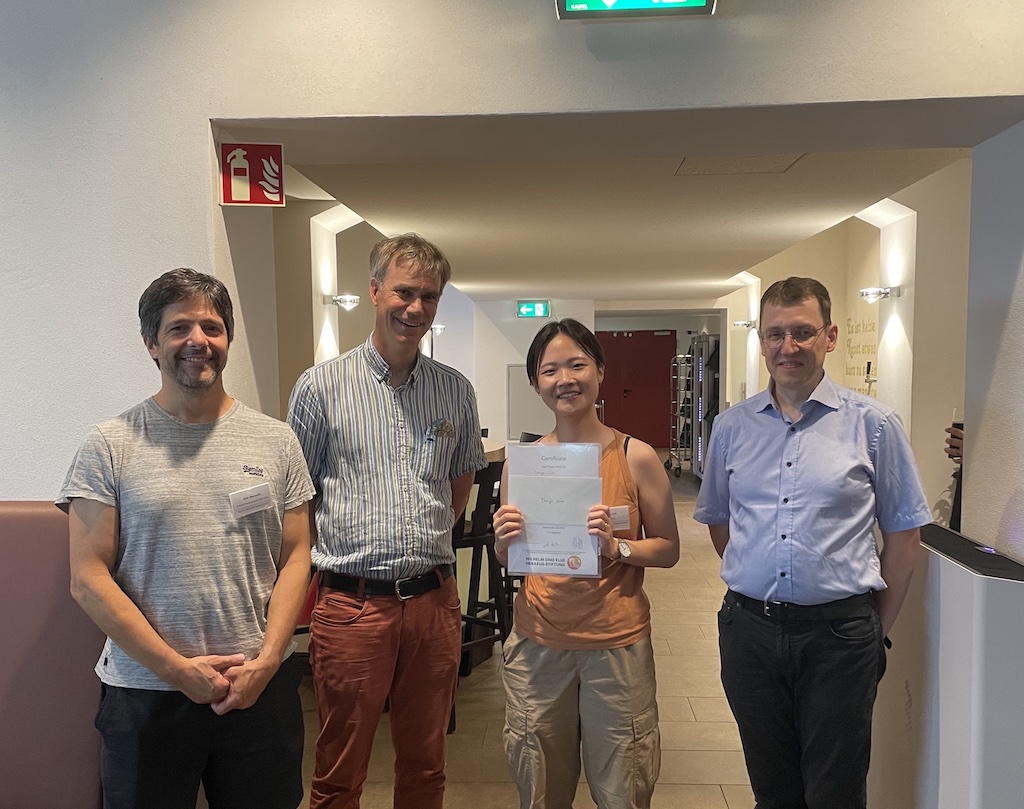
Daye Lim (second from right) from the KU Leuven won a poster price for "Quasi-Periodic Pulsations in EUV Brightenings". The source of all the pictures is the conference website. |
|
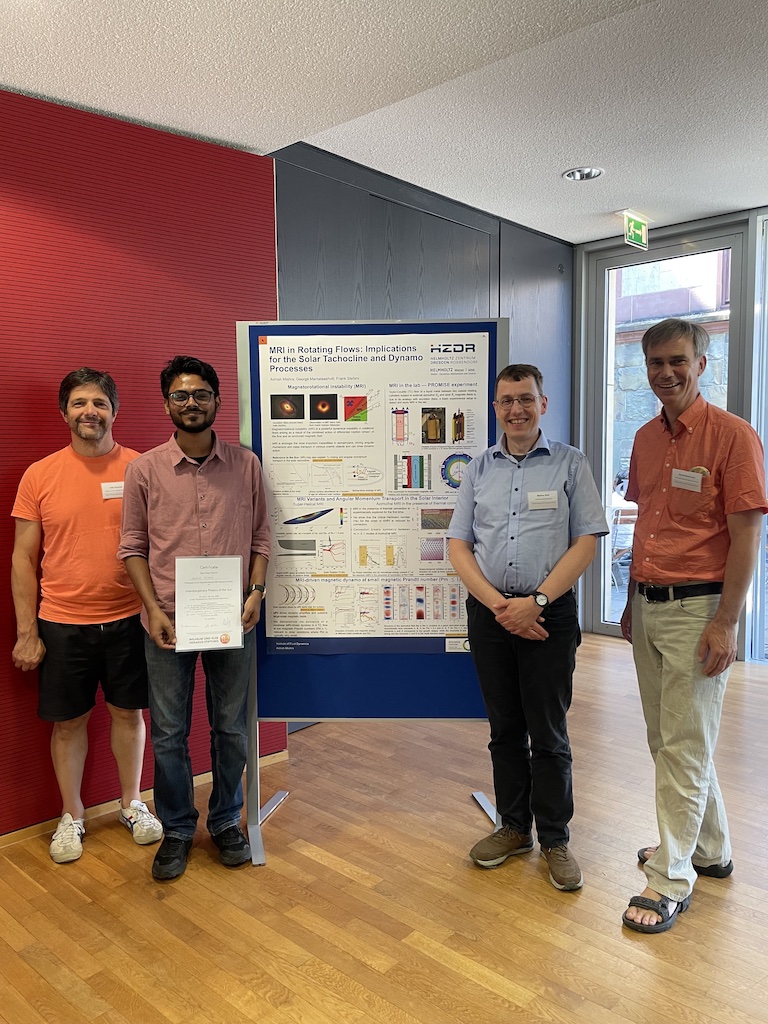
Ashish Mishra's poster also received a price. He works at the Helmholtz-Zentrum Dresden-Rossendorf. The topic was "MRI in Rotating Flows". |
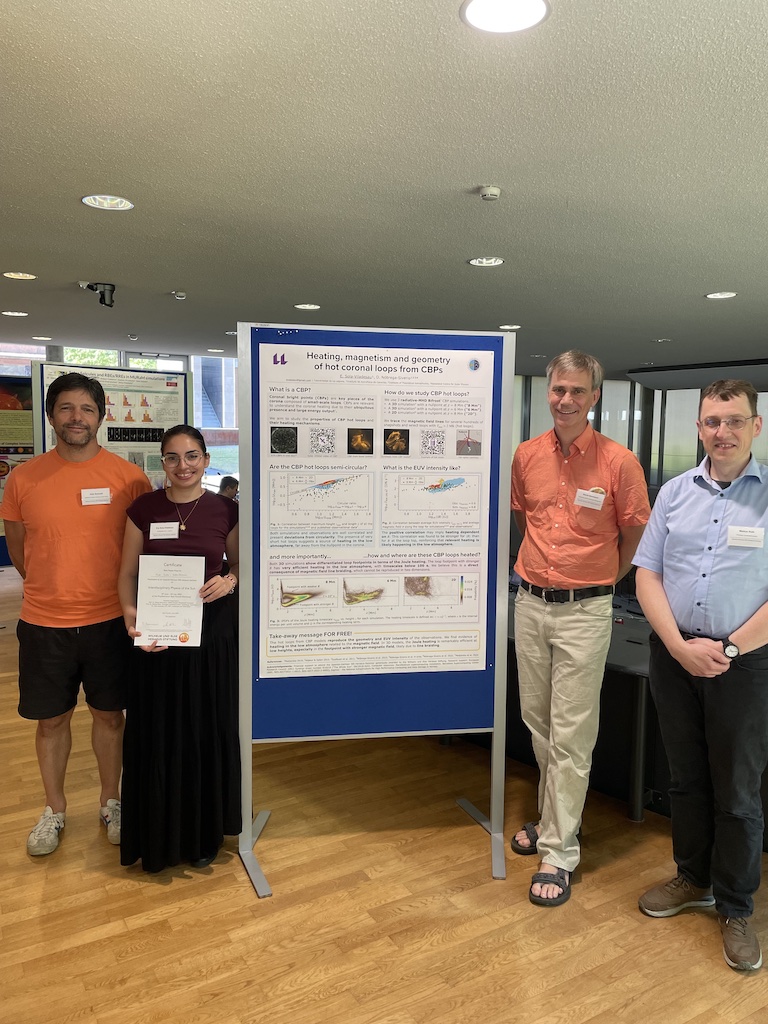
Eva Sola-Viladesau from the Universidad de La Laguna, Spain, got a poster price for "Heating, magnetism and geometry of hot coronal loops from CBPs". |
Students from the Wilhelm-Ostwald-Gymnasium in Leipzig visit the Observatory in Tautenburg
25.06.2025
A group of 25 students from the Wilhelm-Ostwald-Gymnasium (WOG) in Leipzig, together with two teachers, visited the Thuringian State Observatory in June 2025. Visiting an astronomical research facility is a great addition to the content taught in their astronomy class.
Wilhelm-Ostwald-Gymnasium is a public school with an in-depth STEM education (STEM: science, technology, engineering and mathematics). Astronomy courses are also offered for senior students. The idea behind the visit to the observatory was to give students a better idea how astronomers work and to show them the research facilities. Maja Mauksch, a student at WOG, is currently working on her BeLL (BeLL: Besondere Lernleistung, extraordinary learning performance) paper at the Tautenburg Solar Lab TauSoL. She connected the astronomy teachers at WOG with the scientists at TLS so that a group visit could be organized.
 A group of pupils from the Wilhelm-Ostwald-Gymnasium Leipzig visits the Thuringian State Observatory. Foto Credit: TLSAstronomical telescopes and the Sun were the focus of this year's astronomy class. TLS has quite a bit to show for both topics. Shortly before the student group came to visit TLS, Maja Mauksch presented her work at her school. So when the students arrived, they came prepared and had lots of questions about the Sun and the Solar Lab. In addition to the participants in the astronomy course, interested middle school students were also able to register for the excursion. The result: A highly motivated group got off the bus at 9:30 a.m. on Tuesday morning. They were greeted by Michael Sigwarth and Eike Guenther, both scientists at TLS.
"Now I remember again", commented Petra Schupke, one of the teachers who accompanied the group, when she arrived. She had received her degree for teaching astronomy at the Friedrich-Schiller-University in Jena. As part of her studies, she had visited the observatory back then. Ronny Möbius, also a teacher at WOG and advisor of Maja Mauksch, was happy to finally visit the research institution after listening to the reports of his student and exchanging several mails to prepare the excursion.
Visiting the Solar Lab and the optical 2 meter telescope
First, Michael Sigwarth and Eike Guenther told the group details about the history of the observatory. They also described what research is being conducted there. Afterwards, the students were divided into two groups. While one group went to see the optical 2 meter telescope, the other one went to visit the Solar Lab - and vice versa. The first group coming to the solar lab was lucky: They got to see a live picture of the sun, before it disappeared behind clouds. But TLS scientists Michael Sigwarth and Hemanth Pruthvi were prepared. They used pictures to explain how research is done in the Solar Lab.
Meanwhile, Eike Guenther explained how the optical 2 meter telescope works and what it is used for. And he impressed his visitors when he made the dome turn and the telescope move. At 12 o'clock on the dot the group left to return to Leipzig (so that there was no time left for some students to lighten the cherry trees at the observatory). Too bad, especially because the Sun appeared again from behind the clouds. Hopefully, an excursion to TLS will become a permanent component of the astronomy classes at Wilhelm-Ostwald-Gymnasium in the future.
Author: Michael Sigwarth
How a new Camera System provides a more detailed Look at the Sun
20.05.2025
A team of solar physicist, among them Markus Roth, director of the Thuringian State Observatory, got a more detailled view of active regions of the Sun. They used a modern camera system and managed to get high-resolution pictures of Sun spots. The pictures were taken at the Vacuum Tower Telescope at the Observatorio del Teide on the island of Tenerife. The Thuringian State Obseratory (Thüringer Landessternwarte, TLS) plans to use another instrument at this observatory as well.
 Images: R. Kamlah et al. 2025
Large solar telescopes can observe the smallest details on the surface of the sun, but only in small image sections. As a result, they miss out on the big picture: How is the large-scale environment of these active regions developing? Smaller telescopes in space or in earth-spanning networks observe the entire solar disk around the clock, but they cannot zoom into the complex and rapidly changing structures that are shaped by the sun's magnetic field. The Vacuum Tower Telescope (VTT) can meet both requirements because it has a large field of view and good spatial resolution.
A new, modern camera system from the Leibniz Institute for Astrophysics Potsdam (AIP) makes use of the VTT's large field of view. At the same time, it provides detailed images of the surface of the sun by reconstructing images.
High-resolution images of sunspots
For such a reconstructed image, 100 short time-exposure images with 8,000 × 6,000 pixels are required, which are taken at 25 frames per second. This fast image sequence makes it possible to eliminate the disruptive influence of Earth’s turbulent atmosphere from the solar images.
Viewed in time-lapse, the images provide a better picture of the dynamic processes taking place on the surface of the sun. In short: with the new camera system, details of sunspots become better visible, while at the same time their surroundings remain in view - thanks to the VTT's large field of view.
Getting a better understanding of what’s going on in the Sun’s interior
Research into solar activity is a key focus at the Thuringian State Observatory. In addition to the Tautenburg solar laboratory, researchers at TLS will be using another observation instrument to explore our star: the HELLRIDE instrument, which is also located at the Vacuum Tower Telescope at the Observatorio del Teide on Tenerife in Spain. HELLRIDE stands for Helioseismic Large Region Interferometric Device.
Solar physicists want to use instruments such as HELLRIDE, the new camera system, the Tautenburg solar laboratory and other scientific tools to find answers to the following questions: Does the plasma (the particle mixture of ions and electrons that makes up the Sun) change before a solar flare? How can the magnetic field under the surface of the sun be detected? How do sunspots develop and what happens inside them?
To find answers to such questions, astronomers measure the high-frequency seismic waves of the sun. This is known as helioseismology. They look at longer periods of time to find out how active regions with sunspots change before, during and after a solar flare. The data are obtained using the Tautenburg Solar Laboratory and the HELLRIDE instrument at the Vacuum Tower Telescope on Tenerife, among others. Markus Roth explains why this research is important: “Such studies help us to understand how the strength of solar eruptions varies”.
Strong eruptions and coronal mass ejections occur repeatedly on the sun. They hurl huge amounts of matter into space and create shock waves. The solar wind is suddenly amplified and transports many more particles than usual towards Earth. This material (plasma) can affect technological facilities in space and on Earth as a solar storm. This is known as space weather.
Telescopes such as the Vacuum Tower Telescope and the Tautenburg Solar Laboratory can make important contributions to research into solar activity and therefore also space weather.
Links
Article about the high-resolution images of the sun taken with the new camera system:
R. Kamlah et al. 2025, Wide-field Image Restoration of G-Band and Ca II K Images Containing Large and Complex Active Regions, in: Solar Physics,
doi: https://doi.org/10.1007/s11207-025-02472-6
More information on the HELLRIDE instrument (in German):
www.leibniz-kis.de/de/observatorien/vakuum-turmteleskop/instrumente-am-vtt/hellride
Talks and Guided Tours - the Programme for the Open House
06.05.2025
The Thuringian State Observatory invites all astronomy fans to come visit during its Open House on Sunday, May 25th, 2025. Visitors can see the 2-meter Alfred Jensch telescope and the LOFAR radio telescope.
The gates to the observatory grounds will be open from 10 am to 5 pm. Scientists will entertain the public with guided tours and talks about their research.
A broad range of topics
Why is the Sun such a special star for us? Is it actually possible to observe northern lights in Thuringia? How do radio waves draw a map of the sky? As you can tell from these questions, the talks during Open House will cover a wide range of astronomical subjects. All talks will be in German except the talk on "Asteroseismology - The Sound of Stars".
| Time |
Topic | Speaker |
| 10:30 am - 11:15 am | Polarlicht – the Beauty and the Biest | Dr. Jochen Eislöffel |
| 11:30 am - 12:15 pm | Die Sonne - der Stern mit dem wir leben | Prof. Dr. Markus Roth |
| 12:30 pm - 1:15 pm | Der Himmel in Radiowellen: Galaxien am Ende des Universums | Prof. Heinz Andernach |
| 1:30 pm - 2:15 pm | Ein junger Stern beim Wachsen - Familienvortrag für Groß und Klein | Dr. Verena Wolf |
| 2:30 pm - 3:15 pm | Asteroseismology - The Sound of Stars (talk is in English/Vortrag auf Englisch) | Aashana Tripathi |
| 3:30 pm - 4:15 pm | Von Schwarzen Löchern und kosmischen Kollisionen | Prof. Dr. Matthias Höft |
Where to listen to the talks: All presentations will take place in the seminar room on the second floor of the administrative building (Neubau). (Access is not barrier free.)
Visit the 2-meter Alfred Jensch telescope
We will offer guided tours through the telescope building and dome every half hour between 10.15 am and 4.15 pm. During those tours, scientists will also explain how the radio telescope LOFAR and the Tautenburg Solar Laboratory work.
To coordinate the visitor flow, we will hand out tickets to the dome (free of charge). By limiting the amount of visitors per tour we make sure that it does not get too crowded in the dome and in the building. We ask for your understanding that you may have to wait a bit until your guided tour starts.
At 12.45 there will be a guided tour in English.
Special activities for kids
There will be guided tours through the dome for families at 10.45 am, 12.15 pm, 2.45 pm and 3.45 pm. Kids can also paint their own pictures of the night sky. And we will explain to our young visitors how a telescope works with our "Tautenburg Tiny Telescope".
More Highlights:
Live observation with the radio telescope: The radio astronomy team will show our visitors how the LOFAR radio telescope works.
Tautenburg Solar Laboratory: We explain how we learn more about our Sun by using the Tautenburg Solar Laboratory.
A few practical details:
Unfortunately, the dome and the buildings are not barrier free.
The entrance to the Open House event is free of charge, a reservation is not necessary. Group size (per guided tour) to visit the dome with its 2 meter telescope is limited to 70 visitors due to limited space. In order to avoid that too many people are in the dome at the same time, (free) tickets for the tours will be handed out right in front of the dome. We appreciate the interest in the 2-meter telescope and ask for your understanding that you may have to wait a bit until your guided tour starts.
You can buy food and drinks, coffee and cake during Open House.
We are looking forward to your visit on May 25th, 2025!
Reviewing extrasolar planets to find possible patterns
08.04.2025
The “Encyclopaedia of Exoplanetary Systems” currently lists 7.441 extrasolar planets (as of March 2025). With so many known extrasolar planets or planetary systems, astronomers try to find patterns why certain stars have planetary companions and how to characterize and group those planets.
To help answer those questions, Artie Hatzes, former director of the Thuringian State Observatory, will start a new research project. He will review all the planets found by the KESPRINT consortium. The KESPRINT consortium is devoted to detecting and characterizing extrasolar planets found by space-based telescopes like “Kepler” or “TESS” (Transiting Exoplanet Survey Satellite).
Homogeneous database
Reviewing the over 100 extrasolar planets found by KESPRINT has one big advantage: The consortium knows how their observational data was analyzed and that the data was reduced in the same way. Furthermore, the KESPRINT sample has some of the most precise measurements for the masses of small planets. That makes the KESPRINT sample special. “It provides a great base for this review project”, says Artie Hatzes.
The idea for this review project was born during a staff exchange under the EXOWORLD project funded by the European Union. Hatzes visited fellow KESPRINT members at the NINS (National Institutes of Natural Sciences) Astrobiology Center, located at the National Astronomical Observatory of Japan (NAOJ) in Tokyo.
Meeting KESPRINT colleagues for the first time
 Teruyuki Hirano (Associate Professor at NINS Astrobiology Center), Artie Hatzes (Thuringian State Observatory), John Livingston (Assistant Professor at NINS Astrobiology Center) and Norio Narita (professor at the University of Tokyo) are members of the international KESPRINT consortium. Photo: Thuringian State ObservatoryNorio Narita (professor at the University of Tokyo), Teruyuki Hirano (Associate Professor at NINS Astrobiology Center), and John Livingston (Assistant Professor at NINS Astrobiology Center) are also members of the international KESPRINT consortium. Even though Artie Hatzes has worked since many years with Teruyuki Hirano, John Livingston and Norio Narita, they so far had only met via online meetings or briefly at conferences. Thanks to the EXOWORLD project, Hatzes was able to visit his KESPRINT colleagues at NINS Astrobiology Center for the first time.
They discussed ideas on how to better explore the properties of small planets found by the KESPRINT consortium. Hatzes and Hirano also have a shared interest in using high precision radial velocity measurements in the infrared for detecting and characterizing extrasolar planets.
Introducing CRIRES+ and VIPER
The staff exchange program enabled students and post-docs at the NINS Astrobiology Center to learn more about the CRyogenic high-resolution InfraRed Echelle Spectrograph “CRIRES+”. Hatzes was the Consortium Principal Investigator for CRIRES+ , an instrument built by ESO in collaboration with a consortium of European institutes. Hatzes presented the capabilities of the instrument, its performance and what it can do for characterizing extrasolar planets.
He also introduced the VIPER software, a program for a radial velocity reduction pipeline, that is used for reducing observation data taken with CRIRES+. VIPER is developed and improved at the Thuringian State Observatory, and available to the research community as open-source program.
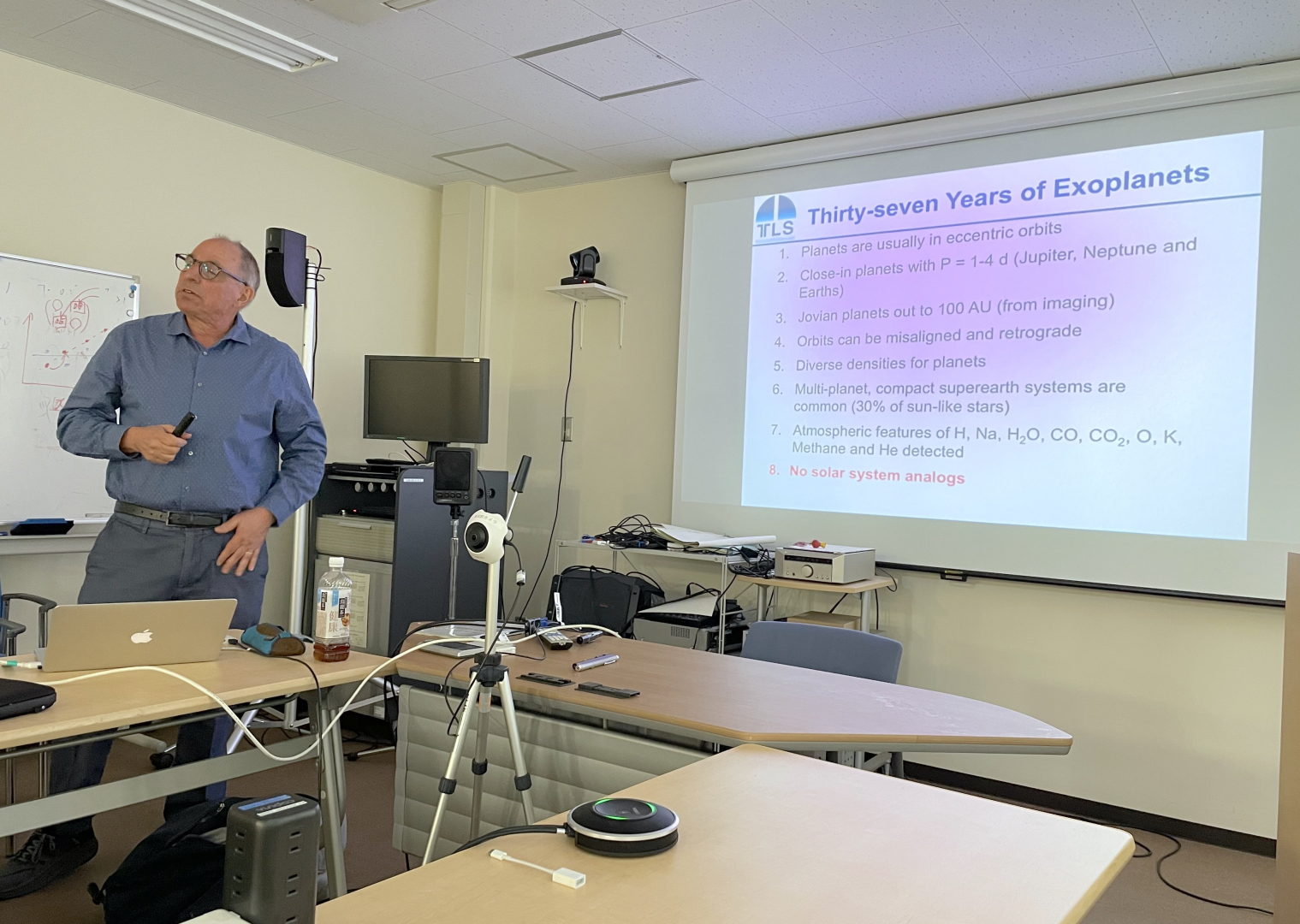 In his talk, Artie Hatzes looked back on an active career in exoplanet research for the past 37 years. Photo: Thuringian State ObservatoryHatzes is one of the few astronomers who has detected and studied extrasolar planets almost from the very onset of this exciting research area. His talk at the NINS Astrobiology Center on how the field of exoplanet research developed over the past almost 40 years, surprises along the way, and lessons learned, was well received.
Background Information
The KESPRINT consortium is devoted to detecting and characterizing extrasolar planets found by space-based telescopes like “Kepler” or “TESS” (Transiting Exoplanet Survey Satellite). KESPRINT provides mass measurements that yield the planet density needed to determine the type of planet (gas giant or rocky.) KESPRINT is one of the most successful teams world-wide for the measurement of masses of transiting exoplanets found by the TESS mission. The KESPRINT consortium consists of 47 members in 9 countries (Germany, Austria, Italy, Spain, Sweden, Denmark, The Netherlands, Japan, and USA). The Thuringian State Observatory is a founding member of KESPRINT.
Hatzes’ research stay was made possible by European Union research funding. The Thuringian State Observatory is part of the EXOWORLD consortium who had successfully applied for Staff Exchanges as part of Marie Skłodowska-Curie Actions (Project ID: 101086149). “Understanding the evolution of EXOplanets and towards habitable WORLDs (EXOWORLD)” is a consortium that comprises 12 organizations from eight countries. It leverages interdisciplinary and international expertise to study the diversity of exoplanets.
Partial Solar Eclipse
31.03.2025
On Saturday, 29. March 2025, a partial solar eclipse occurred, which was visible from Thuringia. The eclipse started with the first contact of the Moon at the edge of the solar disc at 11h27 CET and ended with the last contact of the Moon at 13h03 CET. This photo of TLS shows Sun and Moon at the time of the maximum occultation at 12h15 CET, when the Moon covered 26% of the diameter or 15.6% of the area of the Sun. Several sunspots are visible on the non-occulted part of the solar disc.

(Image: Jochen Eislöffel).
Save the Date: Open House in May
04.03.2025
A date for the Open House 2025 at the Thuringian State Observatory has been set. We invite all astronomy fans to spend time at the observatory in the Tautenburg Forest on Sunday, May 25. More details about the program will be announced soon. You will be able to listen to talks about stars, the sun, galaxies and other celestial objects and talk to astronomers. And, of course, our observation facilities such as the LOFAR radio telescope and the 2-meter optical telescope can be visited. Keep your fingers crossed that the Sun is shining, then observing "our star" might be part of the program.
There is lots to do and see around the observatory as well. Enjoy a hike in the forest or walk along the Tautenburg Planet Path and learn lots about the planets in our Solar System.
The Open House will start at 10 am and last till 5 pm. There is no fee. We are looking forward to seeing you on May 25!
Book on Data-intensive Radio Astronomy published
20.02.2025
One of the most topical issues in radio astronomy is how to process and archive huge amounts of data from modern telescopes. Researchers from the Thuringian State Observatory and the DLR Institute of Data Science in Jena have compiled expert knowledge of this topic in the book "Data-intensive Radio Astronomy".
Large international radio telescopes such as the Low Frequency Array (LOFAR) and the Square Kilometre Array (SKA) generate an almost unimaginably large amount of data. According to experts, the low-band array of the “Square Kilometre Array” in Australia alone will generate 5 zettabytes (106 petabytes) of data every year. By comparison, global internet traffic only exceeded 1 zettabyte for the first time in 2016.
In modern radio astronomy, hundreds of gigabytes of data per second will be collected and processed in so-called pipelines in order to generate scientifically usable results. Processing such huge amounts of data is a major challenge. Astronomers are therefore looking for efficient solutions that will lead astrophysics into the so-called exabyte era.
 Titel of the book "Data-Intensive Radio Astronomy", published by Springer. Screenshot: Springer
Such large amounts of data require data processing to be rethought at all levels. These exemplary questions which scientists try to answer provide an insight into the specific issues at stake: How can such volumes of data be handled: how can they be created, stored or archived? How can the data be compressed efficiently without losing too much information? How can rare events be detected in these huge amounts of data? How can the data be made easily accessible to a large number of scientists? What will the archive of the future look like? And last but not least, how can data processing be made sustainable, i.e. energy-saving?
As part of a project funded by the Carl Zeiss Foundation in Jena to coordinate data-intensive radio astronomy in the Jena science region, Marta Dembska from the Institute of Data Science at the DLR (German Aerospace Center) in Jena as well as Eleni Vardoulaki, Alexander Drabent and Matthias Hoeft from the Thuringian State Observatory have published the book "Data-intensive Radio Astronomy". They have edited the first monograph on this topic with contributions from many international experts, This book brings together knowledge from various fields of research to provide an overview of the current state of data-intensive radio astronomy.
The book was published in November 2024 by Springer Nature Switzerland as part of the series "Astrophysics and Space Science Library". The E-Book version is available at Amazon.
Important Milestone for Upgrade of LOFAR Radio Telescope
18.02.2025
The Thuringian State Observatory has been operating a station of the international LOFAR radio telescope since 2010. The whole telescope is currently being upgraded: The computers and software are being renewed. An important milestone has now been reached with the release of version 5.0 of the “LINC” software. Alexander Drabent, a scientist at the Thuringian State Observatory, has played a major role in this success, as he is the main software developer of LINC 5.0.
LINC is the pipeline for the first processing of the data recorded with LOFAR. The LOFAR radio telescope could also be called a software telescope because the alignment of the non-mobile radio antennas is controlled exclusively by software. In addition, the more than 50 LOFAR stations in currently eight countries generate huge amounts of data, which can only be converted into scientific research results using state-of-the-art IT technology and software.
 Alexander Drabent explains how LOFAR generates an image of the sky. Photo: TLS
The software and its further development are therefore a relevant component of the telescope itself. “All the knowledge and technology of how the telescope observes is largely contained in the software,” explains Alexander Drabent. As the main software developer for LINC, the scientist supervises and maintains the pipeline.
Pipeline is a key component
The pipeline is a key component for the subsequent processing of the observation data. It is used to compare the recorded data sets from the LOFAR stations with a reference model. This is known as calibration and is a central component of the initial processing. “In order to 'understand' observation data and 'translate' it correctly into an image of the radio sky, for example, we need a reference. The LINC pipeline is responsible for making this possible. Almost all data recorded with LOFAR passes through this pipeline,” explains Drabent.
The pipeline eliminates distortions caused by the telescope itself or by environmental influences so that the observation data produces a clearer signal. LINC also analyzes the quality of the observed data and makes the calibration process transparent. The initial calibration is important. Without it, the observation data cannot be processed further.
LINC has already undergone many development steps. Drabent has been working on it since version 3.0. The new version 5.0 covers a much wider bandwidth of the telescope. For the first time, it can be used for data from both LOFAR antenna arrays, the high-band and low-band antennas. This is a prerequisite for the future operation of LOFAR 2.0: Simultaneous observation with both antenna arrays.
Background: Science with LOFAR
With LOFAR, astronomers can look back billions of years to a time before the first stars and galaxies formed (the so-called “dark ages”). They can map vast areas of the low-frequency radio sky with unprecedented resolution and look for radio transients originating from some of the most energetic explosions in the universe.
This video from ASTRON, the Netherlands Institute for Radio Astronomy, demonstrates how LOFAR works.
Day of Physics and Astronomy at Friedrich-Schiller-University Jena
13.02.2025
The Faculty of Physics and Astronomy at Friedrich Schiller University in Jena invites you to the “Day of Physics & Astronomy” on March 6, 2025. Pupils and anyone interested in physics and astronomy will experience an exciting day with lots of experiments.
The faculty's researchers take their guests into the fascinating world of modern science and show how research is done. Guided tours of the ultra-modern laboratories take place every 60 minutes - in cleanroom clothing, of course, which is provided for visitors. During short presentations on topics from quantum physics, gravitational physics and astronomy, everyone can join in the discussion, ask questions and experience science up close.
Markus Roth, Professor of Astronomy and Director of the Thuringian State Observatory, will be giving a lecture on the sun at 9.30 am. The sun is the only star that is close enough for astronomers to study it with high resolution. Solar physicists study sunspots, magnetic activity, helioseismology and space weather. From 10 am to 3 pm, the sun can be observed on the roof terrace of the building at Max-Wien-Platz 1 - weather permitting.
Find the full programm on this website.
Tip: If you are considering whether to study physics or to study at Friedrich Schiller University in general, this is an offer you shouldn't miss. The Infomobile of the Friedrich Schiller University Jena will be stopping at the Day of Physics and Astronomy. The student advisory service offers you the chance to find out more about studying at FSU Jena. From natural sciences to humanities and teaching, everything is on offer. Come along and bring your questions!
The event is free of charge and is aimed at school classes and young people who will soon be graduating from school. For better coordination of the laboratory tours, solar observation, etc., it is helpful if school classes register with the expected number of pupils.
Astronomers at Thuringian State Observatory notice conspicuous change in the spectrum of the recurring Nova T CrB
07.02.2025
In our observing campaign at the Thuringian State Observatory on the recurrent nova T Coronae Borealis (T CrB), we have noticed significant changes in the spectrum of T Coronae Borealis over the last two weeks. The emission lines in the spectrum have risen sharply, indicating a greatly increased accretion rate. Furthermore, emission lines can now be seen that can only occur at a temperature of at least 40000 K. These could be the first signs that the nova is about to erupt. The brightness of the system shows no change yet. We are continuing our observation campaign to catch the outburst of the nova.
The coloured lines show the spectra taken at the indicated dates and time. In February, the intensity of the lines increased dramatically. T shows Universal Time.
Evolution of the hydrogen emission lines around Hα 6560 and Hβ 4860 in the spectrum of T Coronae Borealis in the past two weeks
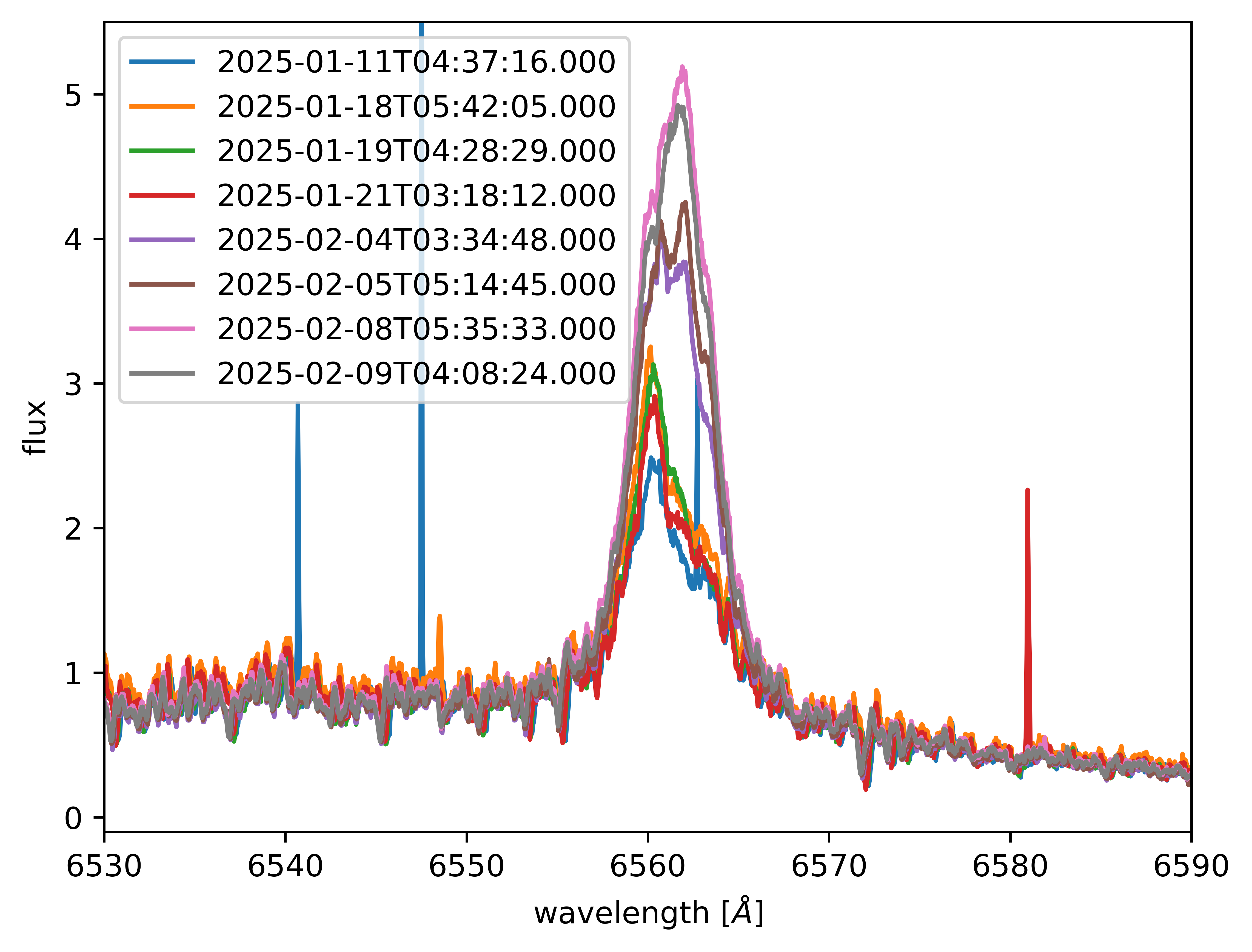

Evolution of the emission line of the neutral Helium He I 5876 and ionized He II 4686, which became visible in the last two weeks


Brightness variability of T CrB in the last 2.5 years (data taken from the AAVSO database): There is no change in the brightness during the increase in the emission lines

More details can be found at Astronomers Telegram.
Contact:
Dr. Veronika Schaffenroth
Markus Roth gives Inaugural Lecture at Friedrich-Schiller-University
28.01.2025
The director of the Thuringian State Observatory, Markus Roth, also teaches at the Faculty of Physics and Astronomy at Friedrich Schiller University in Jena. On January 27, 2025, he gave his inaugural lecture on “The Sun in Focus”.
 Markus Roth gives his inaugural lecture at Friedrich-Schiller-University in Jena. Photos: Thuringian State ObservatoryThe sun is the only star that is close enough for astronomers to study it with high resolution. It is therefore a fascinating object of research for Roth. In his lecture, he described how the sun is structured, how it generates energy and how convection cells make the sun bubble.
Roth also explained why sunspots are so exciting. Sunspots are places of a strong magnetic field. These spots are not always visible on the sun. There are times with more and times with fewer spots. Approximately every 11 years, the sun shows more sunspots. They appear dark because they are cooler than their surroundings. We are currently at solar maximum, which means that the sun is very active.
The sun's changing magnetic field repeatedly causes mass ejections. Solar plasma is hurled into space. These eruptions can also affect technical facilities on Earth as solar storms. Astronomers call these processes that take place in space close to Earth "space weather".
In the new solar laboratory at the Thuringian State Observatory, new compact instrumentation is being developed to enable even better observation of the sun. The researchers want to understand solar activity more precisely and measure the magnetic field more accurately. The big challenge is to eventually better predict space weather.
Markus Roth has only now given his inaugural lecture at Friedrich Schiller University, as no inaugural lectures could take place at the start of his professorship in Jena due to the coronavirus pandemic.
If you would like to find out more about the Sun, visit the “Day of Physics and Astronomy 2025” at the Faculty of Physics and Astronomy. It will take place on March 6. Professor Dr. Roth will give a lecture on “The sun - the star we live with” at 9.30 am. From 10 am to 3 pm, the sun can be observed on the roof terrace of the building at Max-Wien-Platz 1 - weather permitting.
 Markus Roth describes the research goals of the Tautenburg Solar Lab Markus Roth describes the research goals of the Tautenburg Solar Lab |
 Professor Dr. Andreas Marx, president of Friedrich-Schiller-University, Professor Dr. Markus Roth, director Thuringian State Observatory, and Universitäts-Professor Dr. Ulf Peschel, Dean of the Physics and Astronomy Department at Friedrich-Schiller-University Professor Dr. Andreas Marx, president of Friedrich-Schiller-University, Professor Dr. Markus Roth, director Thuringian State Observatory, and Universitäts-Professor Dr. Ulf Peschel, Dean of the Physics and Astronomy Department at Friedrich-Schiller-University |
Extreme winds measured on planet outside our Solar System
21.01.2025
Astronomers at the Thuringian State Observatory have teamed up with international researchers and measured supersonic winds around the equator of WASP-127b, a giant exoplanet. These supersonic jets can reach speeds up to 33.000 kilometers per hour. The discovery provides unique insights into the weather patterns of a distant world.
Up until a few years ago, astronomers could only measure the mass and the radius of extrasolar planets (planets around other stars than our Sun). Now, high-resolution instruments like CRIRES+ at the European Southern Observatory's Very Large Telescope enable scientists to learn more about the dynamics of an exoplanet’s atmosphere.
A team of astronomers, led by Dr. Lisa Nortmann at Georg-August-Universität in Göttingen, studied the atmosphere of the exoplanet WASP-127b using high-resolution infrared spectroscopy. WASP-127b is a type of exoplanet known as a "hot Jupiter" due to its large size and close orbit around its host star. The giant gas planet is slightly larger than Jupiter, but only has a fraction of its mass. Its host star WASP-127 is located over 500 light-years away from Earth.
The planet cannot be observed directly because it is too far away, and the star shines too bright. To find out more about the planet’s atmosphere, the team used an indirect approach: When the planet transits in front of its star, the light of the star travels through the planet's upper atmosphere. The planet's atmosphere blocks certain parts of the star light. Researchers can learn more about the atmosphere based on which parts of the star light are blocked.
Supersonic Winds around the Planet's Equator
The team detected water vapor (H₂O) and carbon monoxide (CO). The speed of the molecules in the atmosphere can be measured. To their big surprise, the researchers have detected two opposing velocity signals. One part of the atmosphere is moving toward the observers at an astonishing speed of nine kilometers per second (almost 33.000 kilometers per hour), while another part is moving away from the observers at the same speed.
 Astronomers have measured supersonic jet winds on WASP-127b, a giant gas planet located about 520 light-years from Earth. Credit: ESOThe researchers conclude that extremely strong winds circulate at supersonic speed at the equator of the exoplanet WASP-127b. The equatorial jet wind moves nearly six times as fast as the planet rotates. “This is something we haven’t seen before,” Lisa Nortmann, lead author of the study, points out.
The extreme wind speeds and the clearly separated signals enable the astronomers to analyze different regions separately. The atmosphere is slightly hotter where the jet stream moves from the bright to the dark side of the planet in comparison to the opposite side (where the jet stream enters the bright side coming from the dark side). There are also differences between the equator and the poles. Since there are no strong signals from the poles, it can be assumed that the climate is colder there.
Distant stars and their planets are observed as point sources while planets in our Solar System can be observed with spatial resolution. "It is exciting to be able to detect differences in various regions of an exoplanet inspite the missing spatial resolution," Nortmann explains the novelty of the results.
A better understanding of weather on distant worlds
Artie Hatzes, scientist at the Thuringian state observatory, is part of the research team and lead the consortium that built the CRIRES+ instrument. He is very content that the high-resolution spectrograph provides such amazing results. „It is great that CRIRES+ at the European Southern Observatory's Very Large Telescope can detect such details in the atmosphere of extrasolar planets. Our understanding of these distant worlds is growing. The results complement observations made with space telescopes". Currently, such research can only be done with ground-based observatories because the instruments on satellite telescopes do not have the necessary velocity precision.
These measurements are a good basis for further research into exoplanet atmospheres. “The detailed mapping of the atmosphere of WASP-127b offers the opportunity to test theoretical circulation models,” Nortmann emphasizes. WASP-127b, with its unique atmospheric characteristics and rapid winds, provides a fascinating case study of atmospheric dynamics on planets far beyond our solar system.
More Information
The research was presented in the paper „CRIRES+ Transmission Spectroscopy of WASP-127b: Detection of Resolved Signatures of a Supersonic Equatorial Jet and Cool Poles in a Hot Planet“ , published today in „Astronomy & Astrophysics“.
* The team is composed of Lisa Nortmann (Institut für Astrophysik und Geophysik, Georg-August-Universität, Göttingen, Germany [IAG]), Fabio Lesjak (IAG), Fei Yan (Department of Astronomy, University of Science and Technology of China, Hefei, China), David Cont (Universitäts-Sternwarte, Fakultät für Physik, Ludwig-Maximilians-Universität München, Germany; Exzellenzcluster Origins, Garching, Germany), Stefan Czesla (Thüringer Landessternwarte Tautenburg, Germany [TLS]), Alexis Lavail (Institut de Recherche en Astrophysique et Planétologie, Université de Toulouse, France), Adam D. Rains (Department of Physics and Astronomy, Uppsala University, Sweden [Uppsala University]), Evangelos Nagel (IAG), Linn Boldt-Christmas (Uppsala University), Artie Hatzes (TLS), Ansgar Reiners (IAG), Nikolai Piskunov (Uppsala University), Oleg Kochukhov (Uppsala University), Ulrike Heiter (Uppsala University), Denis Shulyak (Instituto de Astrofísica de Andalucía, Glorieta de la Astronomía, Spain), Miriam Rengel (Max-Planck-Institut für Sonnensystemforschung, Göttingen, Germany), and Ulf Seemann (European Southern Observatory, Garching, Germany).
Additional Links:
NASA-Webseite: Details about the extrasolar planet WASP-127b
Press release European Southern Observatory (with video and images)
Contact:
Prof. Dr. Artie Hatzes
Thüringer Landessternwarte
Sternwarte 5
07778 Tautenburg
Dr. Lisa Nortmann
Georg-August-Universität Göttingen
Tel: +49 1515 119 54 35
A Tiny Telescope for the Thuringian State Observatory
19.12.2024
Young visitors enthusiastically surrounded the world's largest plug-in building block model of the Alfred Jensch Telescope during the Long Night of Stars 2024 . On that day, it was presented to the public for the first time. The model offers the opportunity to explain to children (and their parents) how the optical telescope works. The Tautenburg Tiny Telescope in the opened model dome. Foto: TLS
Dr. Thomas Sperling und Dr. Christian Andreas, both researchers at the Thuringian State Observatory, completed the brick model in their spare time in around six months with a great deal of dedication. They built a true-to-scale replica of the Alfred Jensch telescope, half of the dome roof and the observation platform which was used for observations in the past. Sperling and Andreas gave the 50-centimetre-high model the name "Tautenburg Tiny Telescope".
It was important to the two scientists to integrate basic functions, such as the movement of the telescope around two axes. "This was ultimately a key requirement for our project. We hope that it will also get the younger generation interested in our work and in astronomy," Sperling said. Originally, the idea was to simply replicate the telescope. Gradually, however, further details - such as the wooden observation platform, part of the dome structure and the TES telescope ("Tautenburg Exoplanet Search Telescope”) were added.
A total of around 4,000 individual parts installed
There was no building plan. "We initially based it on the size of classic LEGO® figures, which also explains the 1:45 scale. We then expanded the model piece by piece using old construction plans and floor plans," Andreas described the process. In total, around 4,000 individual parts were gradually added.
Movable in two directions
Mounting the telescope was a particular challenge. In order for an optical telescope to observe a celestial object - such as a star - throughout the night, two axes of movement are required: from north to south and from east to west in relation to the celestial poles and the celestial equator. "You can think of it like longitude and latitude lines in the night sky", Sperling explained.
For smooth tracking in the sky, the telescope's center of gravity must also be as close to these axes as possible . "You can compare it to a seesaw", Andreas added: "If you want to bob up and down really quickly, the children have to find exactly the right distance from each other so that the weights on both sides compensate for each other".
The Alfred Jensch telescope was designed in such a way that the weight of the telescope tube is balanced along one axis by the mirror, which weighs more than two tons. In the model, around 800 grams of lead plates had to be hidden behind the plastic mirror for this purpose.
Trial and Error - just like in research
The two astronomers had to work hard, but were rewarded with an "extragalactic fun factor", Sperling said. He added: "Of course, we benefited from the fact that we have been enthusiastic about LEGO® since we were children. And the approach was not so different from our scientific work. Even in basic research, it often starts with just an idea. The path to results is then more a matter of trial and error, sometimes accompanied by setbacks, similar to the search for the exit from a labyrinth".
The positive response from the public, young and old, during the Long Night of the Stars shows that the effort was worth it. The two builders permanently handed over the model to the observatory on November 5, 2024, in the presence of the institute's director, Prof. Dr. Markus Roth. It can now also be viewed as part of guided tours of the institute. If you look closely, you may discover other nocturnal superheroes in the model alongside busy astronomers.
Free guided tours of the institute for individuals take place on the first Thursday of each month at 4 pm at the Thuringian State Observatory and last around 45 minutes. Registration is not required.
Author: Christian Andreas
Note: LEGO® is a trademark of the LEGO Group. This website is not sponsored, authorized or endorsed by the LEGO Group.
 A detail in the model of the Alfred Jensch Telescope. Foto: TLS A detail in the model of the Alfred Jensch Telescope. Foto: TLS |
 The observation desk, located in the dome, as a model. Foto: TLS The observation desk, located in the dome, as a model. Foto: TLS |
The Thuringian State Observatory can now also observe the Southern Sky
16.12.2024
As part of an international consortium, the Thuringian State Observatory has put a new spectrograph into operation. This optical instrument is used to study the activity of stars and discover possible companions. The spectrograph was installed on the modernized 1.52-metre telescope of the European Southern Observatory in La Silla, Chile, in November 2024 and is ready for operation. This means that the Thuringian State Observatory now also has an observation instrument for the night sky of the southern hemisphere.
With the new “PLATOSpec” spectrograph on the 1.52-metre telescope of the European Southern Observatory (ESO) in La Silla, Chile, researchers at the Thuringian State Observatory can observe stars in the southern night sky. The telescope was built in the 1960s and has been given new life.
 The modernized 1,52-Metre-Telescope at the ESO La Silla Observatory in Chile. Credit: Zdeněk Bardon/ESOThe Thuringian State Observatory is part of a consortium that had the idea of modernizing the telescope and equipping it with a new spectrograph. After just under two years of construction, the spectrograph was connected to the modernized telescope and tested in November 2024. It is now ready for scientific research.
As part of the modernization the telescope and the spectrograph can be operated remotely. An observation room was set up at the Thuringian State Observatory specifically for this purpose. Markus Roth, Director of the Thuringian State Observatory, explains why this instrumentation project is important for research in Thuringia: “PLATOSpec enables us to observe stars in the southern night sky from Tautenburg and to participate in major international research projects.”
The tasks of the new spectrograph
The new high-resolution spectrograph “PLATOSpec” is a versatile research instrument. It was specially developed to better investigate the magnetic activity of stars. Its main task is to support the European Space Agency's PLATO satellite telescope with observations from Earth. PLATOSpec will characterize stars with planets and search for other planets. The PLATO satellite telescope is due to be launched in 2026 and will initially observe millions of stars in the southern night sky.
These stars will be further examined with telescopes on Earth: How strong is their magnetic activity? Do they possibly have a companion, for example one or more planets orbiting around them? How big is the mass of these planets? PLATOSpec's task is to vet stars: stars that potentially could have Earth-like planets are identified so that they can then be further observed with a large telescope such as ESO's Very Large Telescope (VLT).
An international project
 The various components of the PLATO Spec instrument on the ESO 1.52-m telescope. Credit: Leonardo VanziThe consortium partners who modernized the 1,52-metre-telescope, financed and built the spectrograph PLATOSpec are the Astronomical Institute of the Czech Academy of Sciences (responsible for the telescope modernisation and front end), the German Thuringian State Observatory Tautenburg (calibration unit), the Pontificia Universidad Católica de Chile (spectrograph). The research funding of the Free State of Thuriniga financed the share of the Thuringian State Observatory in the PLATOSpec project.
The workshops of the Thuringian State Observatory have developed, built and tested the calibration unit for the PLATOSpec spectrograph. The calibration unit serves as a reference point for the spectra recorded with the telescope. It was installed on the telescope at the end of March 2024 together with a new front end. The front end connects the spectrograph to the telescope. It was also commissioned by the Thuringian State Observatory and financed by the Free State of Thuringia.
Eike Guenther, astronomer at the Thuringian State Observatory, helped plan the project and accompanied the commissioning of PLATOSpec at ESO's La Silla Observatory in Chile: “With PLATOSpec and the modernized telescope, the Thuringian State Observatory now has the opportunity to observe stars at one of the best astronomical locations in the world. I am delighted that we can make an important contribution to the PLATO satellite telescope with this instrument.”
Links
Machine Learning meets Astronomy in Tautenburg
06.12.2024
There are a lot of advantages (and a few disadvantages) to applying Machine Learning to astronomy data sets. Rok Hribar, expert in Machine Learning, visited the Thuringian State Observatory in November 2024 to get a few projects going.
 Artie Hatzes (left) and Rok Hribar at the Thuringian State Observatory. Photo: TLSHribar is a researcher at the Computer Systems Department at the Jožef Stefan Institute in Ljubljana, Slovenia. He currently spends a year at DLR (Deutsches Zentrum für Luft- und Raumfahrt) in Berlin as part of the EXOWORLD staff exchange program supported by the European Union. The Jožef Stefan Institute is the leading Slovenian scientific research institute, covering a broad spectrum of basic and applied research. Like the Thuringian State Observatory, it is part of the EXOWORLD consortium. Artie Hatzes, researcher at TLS, invited Rok Hribar to spend a week in Tautenburg to talk to astronomers about joint Machine Learning projects. “It is great to have the opportunity to collaborate with an expert in Machine Learning because there are many applications in Astronomy that profit from it,” Hatzes says.
Automating the process of data reduction
Astronomers produce a lot of observational data. Ideally, Machine Learning can automate the process of reducing and analyzing this data – doing it much faster than people can ever do it. “With Machine Learning, we can model things that people cannot process because the data set is too big. Machine Learning also reduces manual labor,” Hribar emphasizes the advantages.
In his colloquium talk, the computer expert described how Machine Learning is applied to astronomical data sets. Hribar already started a few projects with astronomers at DLR in Berlin, at Rheinisches Institut für Umwelt-Forschung an der Universität Köln in Cologne, and at Universita degli Studi di Torino, Italy. These institutes are also part of the consortium “Understanding the evolution of EXOplanets and towards habitable WORLDs (EXOWORLD)”.
How to set up a Machine Learning project
Hribar explains that a Machine Learning project is always an iterative process. First, the astronomers tell him, what problem they want to solve. Before starting, it is essential to discuss the problem in depth with the astronomer. Hribar outlines how he tackles a problem: “It is always useful to understand the astronomical question very well because that influences which method we will apply.”
“Usually people already have ideas where Machine Learning can be applied,” Hribar says. At the beginning, he looks at the data set which is used to train the Machine Learning model. What properties does the data have? Which properties are most important to solve the problem?
A Trial-and-Error-Process
The next step is choosing the methodology. That means preparing the data and choosing the appropriate Machine Learning model. “Preparation of the data is 90 percent of the work,” Hribar points out. When a chosen model works satisfactorily, the data and the model are fine-tuned. This is a trial-and-error-process.
One disadvantage can be that Machine Learning can hide things, Hribar says: “Traditionally, when you use a software to reduce data, you understand what the software is doing. With Machine Learning you don’t really know what the model is doing”. Therefore, one big question still is: How trustworthy are the results?
In order to deal with this question, a step by step process is applied: “We see the intermediate results and can better understand what the model is doing or where it might be wrong,” Hribar describes the correction mechanism. Validating each step brings confidence that the results are trustworthy.
During his visit to Tautenburg, Rok Hribar started some projects with scientists at the Thuringian State Observatory that will be developed further. Hatzes thanks him for sharing his expertise: “I really appreciate that Rok Hribar took his time to visit the Thuringian State Observatory. The scientists here were very interested in talking to him about possible projects.”
Background Information
The EXOWORLD project that funds Hribar’s research stay at DLR in Berlin is supported by the European Union under the Horizon Europe Programme Marie Skłodowska-Curie Actions Staff Exchanges (Project ID: 101086149). “Understanding the evolution of EXOplanets and towards habitable WORLDs (EXOWORLD)” is a consortium that comprises 12 organisations from eight countries. It leverages interdisciplinary and international expertise to study the diversity of exoplanets.